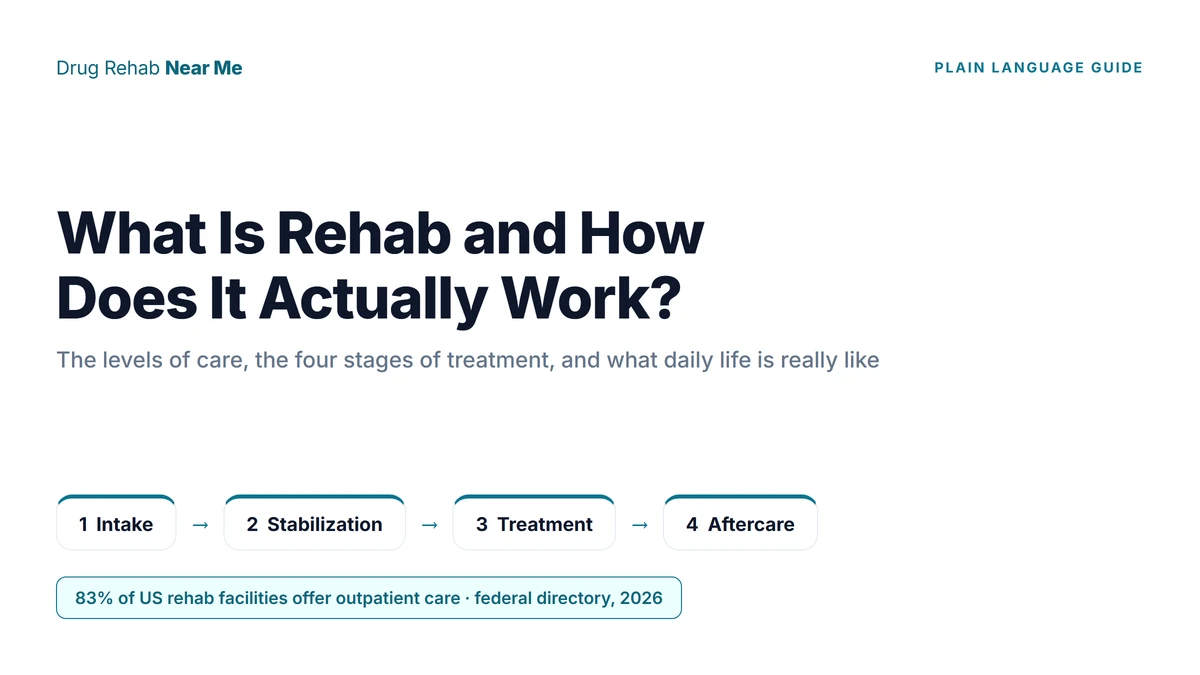
Rehab is structured treatment that helps a person stop using drugs or alcohol and build a life that does not depend on them. A typical program combines medical care, behavioral therapy, group support, and a plan for staying well after treatment ends. Rehab can mean living at a facility for a month or more, but most addiction treatment in the US actually happens on an outpatient basis, at a clinic you visit while living at home.
Nobody researches what rehab is out of idle curiosity. Usually a doctor has said the word out loud, or a family conversation finally happened, or you caught yourself typing the question at 1am. Whichever it is, this guide walks through the whole thing in plain language: what rehab treats, the levels of care, how the process works stage by stage, and what daily life inside a program looks like.
If you would rather talk than read, you can call (888) 470-5244 any time. It is free, confidential, and there is no obligation attached.
What Is Rehab, Exactly?
Rehab is short for rehabilitation. In everyday American English it almost always means a treatment program for addiction. The word has a second life in hospitals, where it refers to physical rehabilitation after a stroke, surgery, or injury, and search results often mix the two up. This guide covers drug and alcohol rehab.
What rehab treats is a substance use disorder: a pattern of drug or alcohol use that a person cannot reliably control even when it is damaging their health, work, or relationships. That covers alcohol, opioids like heroin and fentanyl, stimulants like methamphetamine and cocaine, prescription pills, and combinations of them. Most good programs also treat the mental health conditions that tend to travel with addiction, such as depression, anxiety, and PTSD. Clinicians call this dual diagnosis treatment, and it matters, because treating the addiction while ignoring the depression underneath it rarely holds.
One thing the definition hides: rehab is not a single product. It is a system of levels, from an hour of counseling a week to 24 hour residential care, and the right question is not "should I go to rehab" but "which level fits my situation". More on that below.
What Rehab Is Not
The television version of rehab has done real damage to people's willingness to get help, so it is worth clearing the myths before going further.
- It is not a lockup. Outside of court-ordered treatment, rehab is voluntary. The doors are not locked, and you can leave, even when staff advise against it.
- It is not a cure. Addiction is a chronic condition. Treatment works for many people, but no honest program promises a fix, and anyone who guarantees results is selling something.
- It is not one thing. A retired teacher tapering off wine, a 24 year old using fentanyl, and a nurse with a pill problem will get different programs, different therapies, and different timelines.
- It is not always a 28 day stay. The month-long live-in program is one option among many, and as the numbers below show, it is not even the most common one.
- It is not only for rock bottom. People enter treatment with jobs, marriages, and mortgages intact. Earlier is easier, not weaker.
The Levels of Care: What "Going to Rehab" Can Look Like
Here is the picture most people have wrong. We analyzed the federal FindTreatment.gov directory, which lists 8,656 US facilities offering substance use treatment as of 2026. Of those, 83% offer outpatient care. Only 24% offer residential beds. The locked-away-for-a-month image is the exception, not the rule; most American addiction treatment happens while people keep living at home.
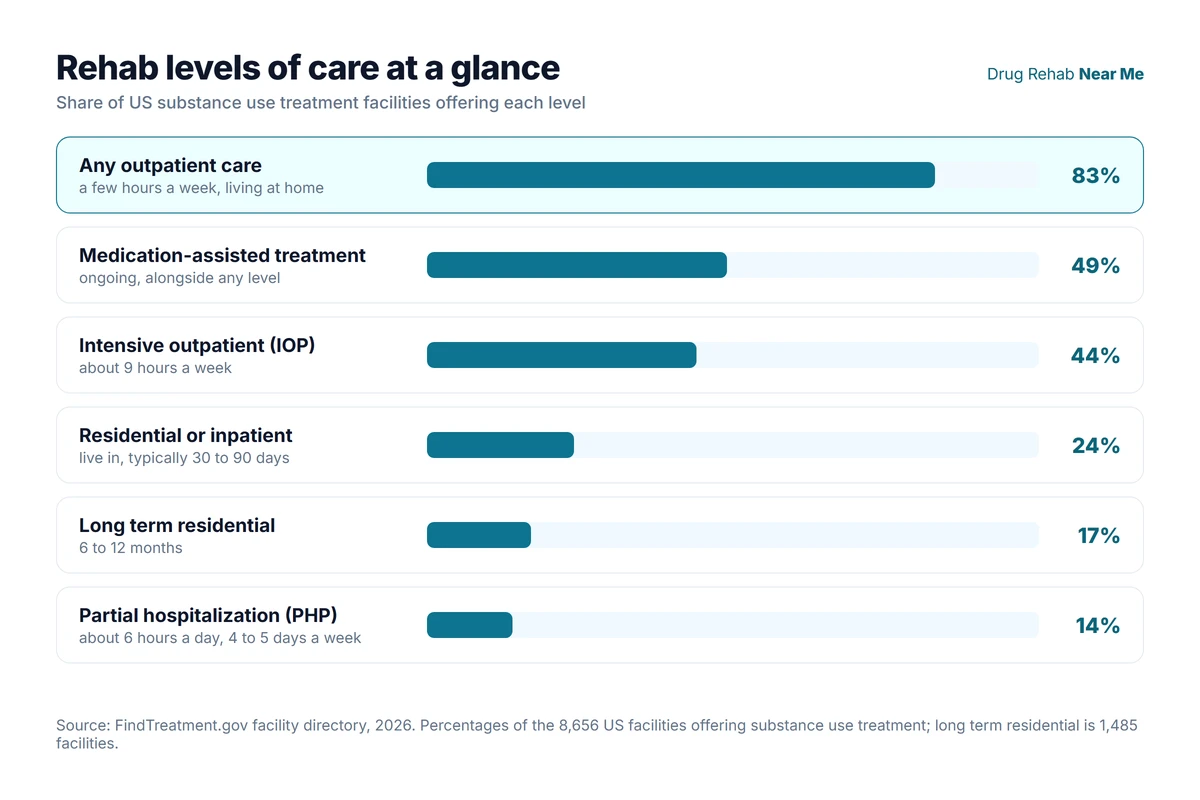
The levels, from lightest to most intensive:
Standard outpatient
Individual or group counseling for a few hours a week, scheduled around work or school. It suits milder substance problems and people with stable homes. Browse outpatient programs in Texas to see what these look like in practice.
Intensive outpatient (IOP)
Around 3 hours of treatment a day, roughly 3 days a week, so 9 or more hours in total. You still sleep at home. About 44% of US facilities offer an IOP, making it one of the most available formats anywhere; see for example intensive outpatient programs in California.
Partial hospitalization (PHP)
Roughly 6 hours a day, 4 to 5 days a week. It is the most structure you can get while still going home at night, and programs often use it as a step down from residential care. About 14% of facilities offer it.
Residential and inpatient
You live at the facility with staff around the clock, typically for 30 to 90 days. This level fits severe addictions, unsafe home environments, and people who have tried outpatient care without traction. Compare inpatient programs in Texas or residential programs in California.
Long term residential
Programs measured in months rather than weeks, often 6 to 12. Federal directory data shows 1,485 facilities run long term residential programs as of 2026. They suit people rebuilding from years of heavy use; here are long term programs in Florida as a starting point.
Medication-assisted treatment (MAT)
Methadone, buprenorphine, or naltrexone combined with counseling, mostly for opioid and alcohol use disorders. It runs alongside any of the levels above, and 49% of US facilities offer outpatient medication treatment. See medication-assisted programs in Texas for real examples.
Not sure which side of the line you fall on? Our inpatient vs outpatient guide walks through the decision properly.
How Does Rehab Work? The Four Stages
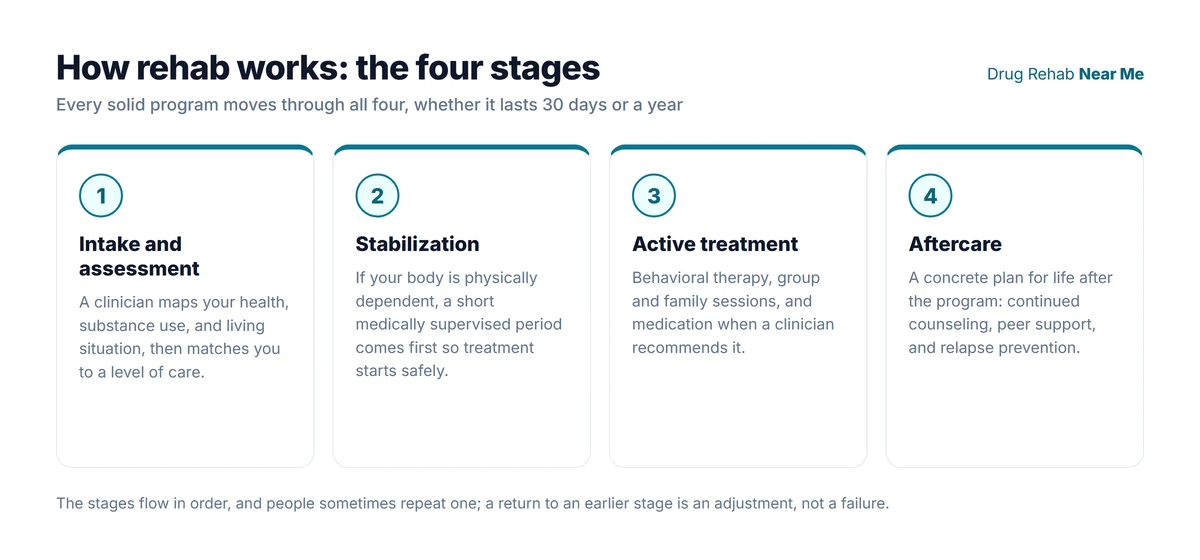
Rehab works in four stages: an intake assessment that maps your health and substance use, stabilization so your body is safe, active treatment built on behavioral therapy and sometimes medication, and an aftercare plan for life after the program. Every solid program moves through all four, whether it lasts 30 days or a year.
Stage 1: Intake and assessment
Before anything else, a clinician sits down with you (in person or by phone) and builds the full picture: what you use, how much, for how long, your medical history, your mental health, your living situation. This is not an interrogation. It is how the program decides which level of care fits and what your treatment plan should contain. Honest answers here buy you better treatment, and everything you say is protected by federal confidentiality rules.
Stage 2: Stabilization
If your body has become physically dependent, treatment may begin with a short, medically supervised detox period so you are stable and safe before therapy starts. The program you contact will tell you whether you need this step and will arrange it; you do not have to figure it out yourself.
Stage 3: Active treatment
This is the core of rehab, and it is mostly talking and practicing, not lying in a hospital bed. Cognitive behavioral therapy teaches you to catch the thoughts and situations that lead to use and respond differently. Group therapy puts you in a room with people fighting the same fight, which does something individual sessions cannot. Family therapy repairs the relationships addiction strained, and many programs use contingency management, which rewards verified progress. For opioid and alcohol use disorders, medication is often part of the plan, and the evidence behind it is as strong as anything in addiction medicine.
Stage 4: Aftercare
Treatment that ends at the front door tends not to last. Before you finish, a good program builds your aftercare plan: continued counseling at a lower intensity, peer support meetings, sometimes a stay in sober living housing, and a concrete relapse prevention plan that names your risks and your responses. Programs that skip this step are cutting the corner that matters most.
What Rehab Is Like Day to Day
Residential rehab runs on structure, and that is deliberate. Addiction thrives on chaos; treatment rebuilds routine. A typical day starts with an early wake-up and breakfast, moves into a morning group session, then individual therapy before lunch. Afternoons carry skills workshops, a second group, or complementary sessions like exercise or meditation, depending on the program. Evenings usually bring a peer support meeting and some free time before lights out. Weekends loosen up a little, often with visiting hours.

Outpatient rehab feels completely different: life continues, and treatment slots into it. You go to work, sleep in your own bed, and show up for your scheduled sessions the way you would for any standing appointment.
The details people worry about most, phones and visitors, vary by program. Many residential programs restrict phone use for the first stretch and then allow scheduled access, while outpatient programs place no restrictions at all. Ask before you enroll. It is a fair question and intake staff answer it every day.
How Long Rehab Takes
Programs commonly run 30, 60, or 90 days, with outpatient care often stretching longer at lower intensity. Research published by the National Institute on Drug Abuse finds that stays shorter than 90 days tend to have limited effect, which is why clinicians often talk about 90 days of total treatment across levels rather than one short stay. The full breakdown, including who each length fits, is in our guide to how long rehab lasts.
What Rehab Costs
Published 2026 price guides put a 30 day outpatient program at roughly $1,400 to $10,000 and a 30 day inpatient stay at $5,000 to $20,000, with most insured people paying far less than sticker price. Federal law lists addiction treatment as an essential health benefit, so most plans must cover it at some level. The honest, detailed version of this topic, including what to do with no insurance at all, lives in our rehab cost guide and our insurance coverage guide.
Does Rehab Actually Work?
Honest answer: it works for many people, and it does not work on the first try for everyone. The National Institute on Drug Abuse describes addiction as a treatable chronic condition, in the same family as diabetes or high blood pressure. Nobody calls those diseases hopeless because symptoms can return; a return to use after treatment means the plan needs adjusting, not that the person is beyond help.
What genuinely improves the odds is staying in treatment long enough, following through on aftercare instead of treating discharge day as the finish line, and using medication when a clinician recommends it. What worsens the odds is leaving early, skipping the aftercare plan, and going back to the same untouched environment. Rehab gives people tools and a running start. It cannot promise an outcome, and you should be suspicious of any program that does.
How to Take the First Step
Reading about rehab is genuinely useful, but at some point the research has to turn into a phone call. Three realistic ways in:
- Talk it through with a person. Call (888) 470-5244, any hour. Describe your situation and get help thinking through levels of care and next steps. Free, confidential, no commitment.
- Browse what actually exists near you. Every listing in our state directories shows the levels of care and payment options each facility reports to the federal government, so you can shortlist programs before you ever pick up the phone.
- Start with a doctor. A primary care physician can assess you, refer you, and in some cases prescribe medication for alcohol or opioid use disorder directly.
If you are researching for someone else who is not ready to hear it yet, our guide on how to help someone who drinks too much covers that harder conversation. And a disclosure worth repeating: Drug Rehab Near Me is an informational directory and referral service, not a treatment provider.
One thing outranks everything on this page: if you or someone near you is in immediate danger, call 911. If you are thinking about suicide or are in emotional crisis, call or text 988. Treatment questions can wait until everyone is safe.
Frequently Asked Questions
What does rehab mean?
Rehab is short for rehabilitation, which means restoring a person to health or normal life. In everyday US usage it refers to a drug or alcohol treatment program, though hospitals also use the word for physical rehabilitation after injury, surgery, or stroke.
What is rehab like?
Residential rehab is structured and busy: therapy groups, individual sessions, meals, and peer meetings fill a scheduled day. Outpatient rehab feels more like a standing appointment layered onto normal life. Neither looks much like the movies.
If you go to rehab, does it go on your record?
No. Rehab is private medical care, not a legal proceeding, so it does not appear on criminal background checks. Treatment records carry extra federal confidentiality protection beyond ordinary medical privacy law, and the main exception is court-ordered treatment, where the court case itself, not the rehab, creates the public record. Worried about your job specifically? Our rehab and job protection guide covers your rights at work.
Can you have your phone in rehab?
It depends on the program. Many residential programs restrict phones during the first days, then allow scheduled use, while outpatient programs place no limits outside session hours. Policies vary enough that it is worth asking during your first call.
Is rehab only for drugs and alcohol?
No. The same treatment structure exists for gambling, eating disorders, and other behavioral conditions, and hospitals run physical rehabilitation programs that share nothing but the name. Substance use programs are the largest group: the federal directory lists 8,656 US facilities treating drug and alcohol problems as of 2026.
Can you leave rehab whenever you want?
In most cases yes. Voluntary treatment is exactly that, and staff cannot hold you, though they will usually urge you to stay and finish. The exception is treatment ordered by a court; a few states also let families petition for involuntary treatment, which our Marchman Act guide explains using Florida's well-known law.
Free & confidential, 24/7
Not sure which program fits? Talk it through with someone who can help.