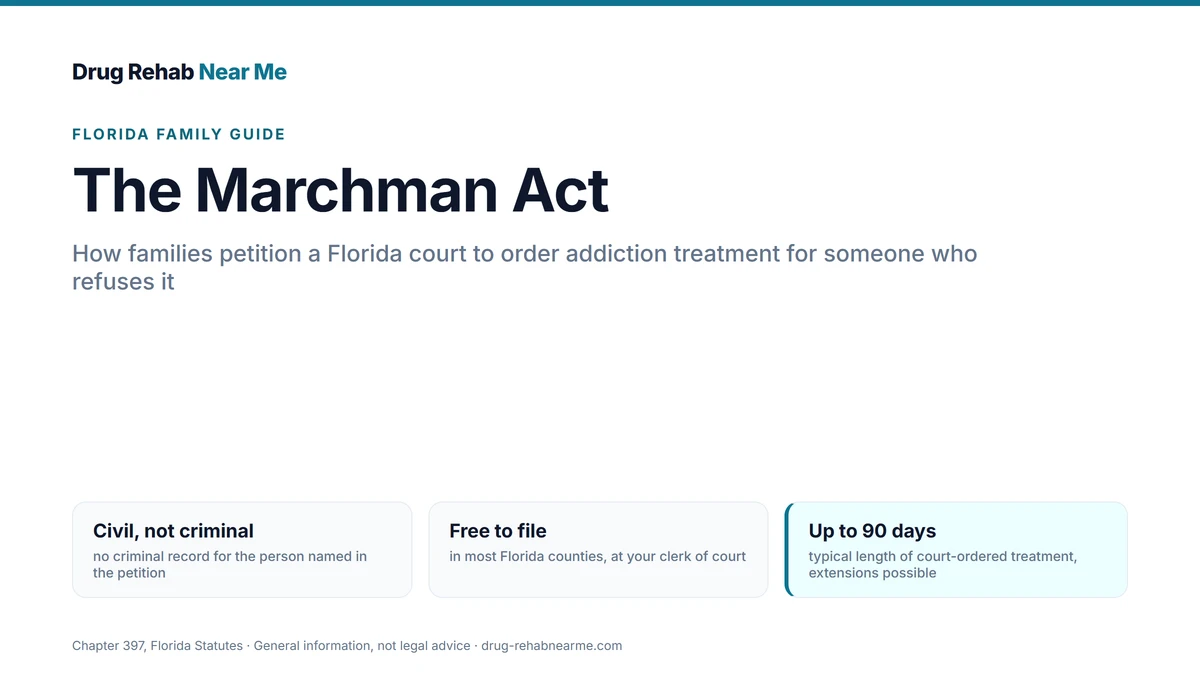
The Marchman Act is a Florida law that lets a family ask a circuit court to order someone into substance abuse assessment and treatment, even if that person refuses to go. It is a civil process, not a criminal one: nobody gets a record for being the subject of a petition. The law has been on the books since 1993, lives in Chapter 397 of the Florida Statutes, and is named for the Reverend Hal S. Marchman, a Daytona Beach minister who spent his life working with people in addiction.
Families usually find this law at a desperate moment: after an overdose scare, a second DUI, or a string of refused offers of help. This guide walks through the whole process in plain English: who qualifies, who can file, what filing actually looks like at the courthouse, the timeline, the costs, and what happens after a judge signs the order.
One thing before we start. This article is general information, not legal advice. Marchman Act procedures genuinely differ from county to county, forms get revised, and the details of your situation matter. The clerk of court in your county can explain the local process, and a Florida attorney can advise on your specific case. Use this guide to understand the terrain, not as a substitute for either.
Who Qualifies: The Marchman Act Criteria
A judge cannot order treatment just because someone drinks too much or because their family is worried. The petition has to show two things about the person, and both must come from substance abuse:
- They have lost the power of self-control over their substance use. The drinking or drug use is running them, not the other way around.
- They are a danger to themselves or others, or they are so impaired they cannot see that they need help. Danger can mean threats and violence, but it also covers self-neglect: someone whose substance use has them skipping food, medical care, or basic safety.
Evidence is what separates granted petitions from denied ones. Vague worry ("he drinks every night and I'm scared") is weak. Specific, dated, firsthand facts are strong: the March 3rd overdose the ER treated, the DUI arrest in June, the night she passed out with the stove on, the weight loss and missed dialysis appointments. You will swear to these facts in writing, so stick to what you personally saw or can document. Petitions built on rumor or on one bad night tend to fail.
Who Can File a Marchman Act Petition
Florida keeps the door reasonably wide. The Eleventh Judicial Circuit, which handles Miami-Dade, lists the people who can petition: a spouse, a relative, a legal guardian, or a friend with direct knowledge of the person's substance abuse, plus sheriffs and treatment center representatives. Under the statute's traditional rule, a spouse, relative, or guardian can file alone, and where none is available, three adults with direct personal knowledge of the person's substance use can file together.
For a minor, a parent or legal guardian files, and some circuits route juvenile cases through their family court division rather than the probate division that handles adults. Counties do differ on the fine print, which is one more reason your first call should be to your county clerk.
How to Marchman Act Someone in Florida: Step by Step
Here is the process as it actually unfolds, from kitchen table to treatment order.
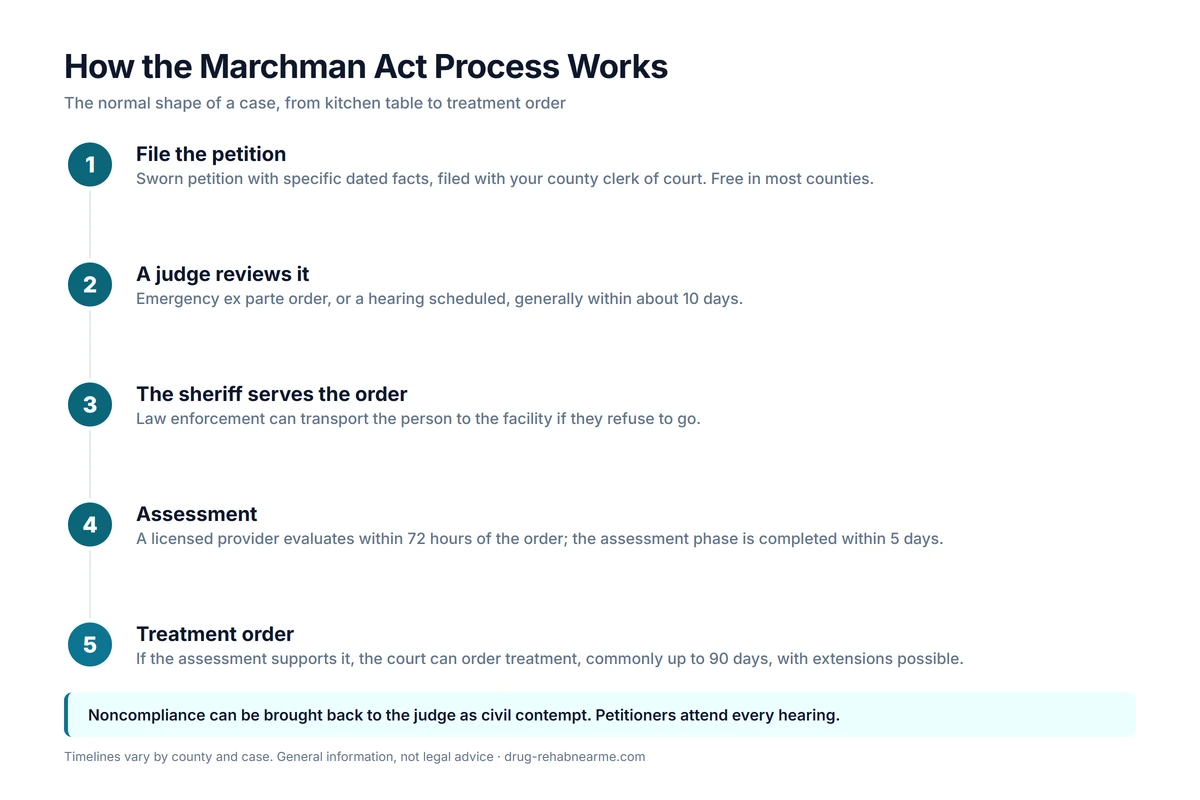
- Call your county clerk of court and ask for the Marchman Act packet. Every county maintains its own forms and instructions. Some publish them online (Miami-Dade's circuit posts a full instruction packet and even staffs a mental health section you can phone); in smaller counties you may need to pick the packet up in person. Ask two questions while you have them: whether there is any fee, and whether your county requires anything extra, like a notice of related cases.
- Fill out the petition with specific, sworn facts. This is where the evidence section above becomes real. Dates, incidents, what you saw with your own eyes. The petition is sworn testimony, typically signed before a notary or a deputy clerk.
- File it with the clerk. In most Florida counties, filing a Marchman Act petition is free. You are opening a civil case, and the clerk will give you a case number.
- A judge reviews the petition. Depending on how urgent the facts are, the judge may issue an order right away without a hearing (called ex parte) or schedule a hearing, generally within about 10 days. If a hearing is set, the person you filed about (the respondent) has the right to be there and to have a lawyer.
- The sheriff serves the order. If the respondent will not come in on their own, law enforcement is authorized to take them to the assessment facility. This is the teeth of the law, and it is also the part families find hardest to watch.
- The assessment happens fast. Once a judge orders an involuntary assessment, a licensed provider evaluates the person within 72 hours, and the assessment phase is completed within 5 days. The assessor answers one question: does this person need involuntary treatment?
- The court rules on treatment. If the assessment supports it, the judge can order involuntary treatment, commonly for up to 90 days, at a licensed provider. Extensions are possible if the provider or the petitioner asks for them and the court agrees.
Show up to every hearing. The petition does not argue itself; judges expect the petitioner there, testifying to what they wrote. Petitions have been dismissed simply because the family member who filed never appeared.
The Marchman Act Timeline at a Glance
- Day 0: Petition filed with the clerk. Case opened.
- Days 1 to 10: Judge reviews; ex parte order or hearing, generally within 10 days. Sheriff serves the respondent.
- Assessment window: evaluation within 72 hours of the order; assessment completed within 5 days.
- Treatment order: commonly up to 90 days.
- Extensions: possible on request, with court approval.
Treat these numbers as the normal shape of a case, not a guarantee. Court calendars, county procedures, and bed availability all move real dates around.
What the Marchman Act Costs
Three separate costs hide inside a Marchman case, and families should see all three coming:
- Filing: free in most counties. Confirm with your clerk.
- The assessment: if it is not covered by insurance or done at a public facility, court-ordered assessments typically run $500 to $1,500.
- Treatment itself: this is ordinary rehab economics, and it is the big number. Residential programs commonly run $5,000 to $20,000 for 30 days, with some private programs far above that, while outpatient care costs much less. Our guide to rehab costs breaks down the real ranges, and our insurance guide explains how to verify coverage in one phone call, because most health plans do cover addiction treatment.
A court order does not create a free bed. Public receiving facilities and state-funded slots exist, and Medicaid covers treatment for those who qualify, but the respondent and family generally carry whatever costs insurance does not. Knowing the money picture before the hearing saves families from a brutal surprise after it.
After the Judge Signs: What the Order Actually Does
An involuntary treatment order sends the person to a licensed service provider, which can be a public receiving facility or a private program that accepts court-ordered clients. The order spells out the treatment and the duration.
What if they walk out or keep using? The order has enforcement behind it. A respondent who violates a treatment order (leaving the program, refusing sessions, continued drug or alcohol use) can be brought back before the court for civil contempt, and the Miami-Dade circuit is blunt that contempt can include time in a detention facility. In practice, the contempt threat is the lever: most respondents comply because the alternative is a cell instead of a counselor.
Petitioners are not spectators after filing. If the person stops complying, it is typically the family that files the motion for a contempt hearing. And the road runs both ways: a petitioner who believes the case should end can ask to withdraw it, and Florida DCF publishes a standard form for exactly that.
Marchman Act vs Baker Act: Which One Applies
Florida has two involuntary care laws, and families mix them up constantly. The Baker Act covers mental health crises: it allows an emergency hold of up to 72 hours for psychiatric evaluation, and it is usually initiated by police, doctors, or mental health professionals in the moment. The Marchman Act covers substance abuse: it is usually initiated by the family through a court petition, moves on a courtroom timeline instead of an emergency one, and can result in treatment orders lasting months rather than days.
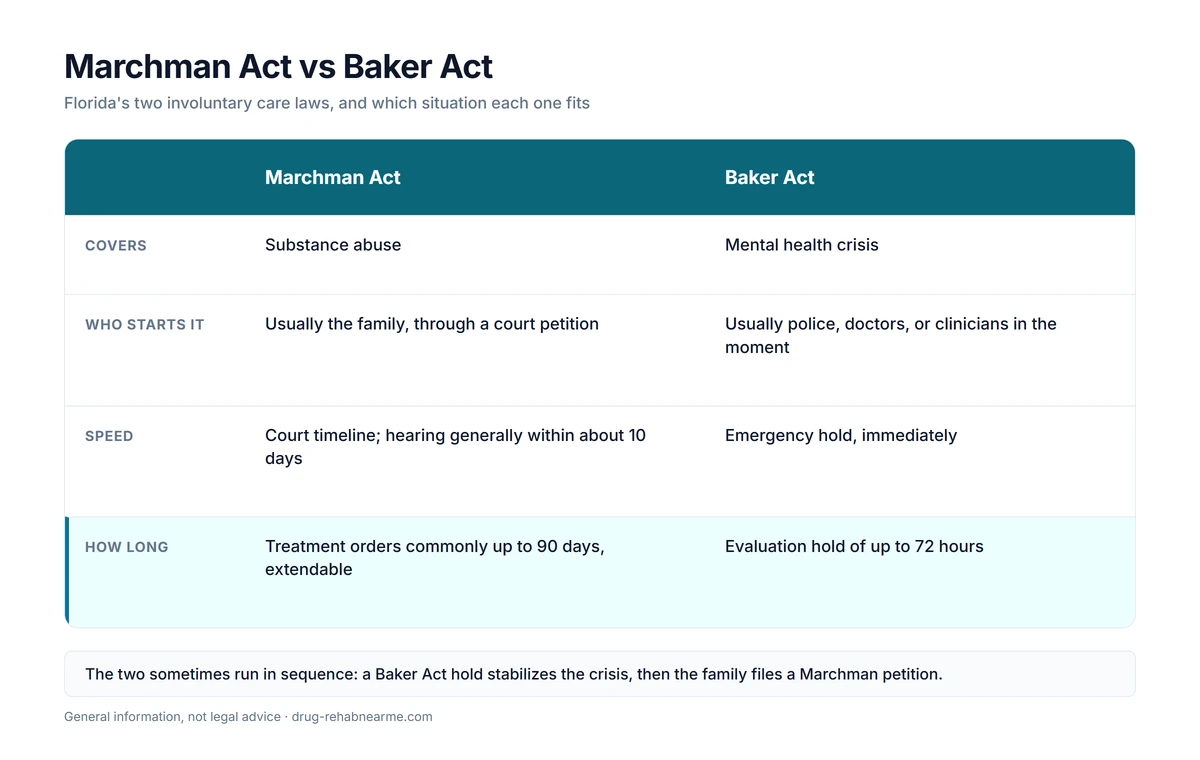
The two laws sometimes run in sequence. A psychotic episode brought on by drug use might trigger a Baker Act hold first, and the family files a Marchman petition while the person is stabilized. If you are unsure which fits, describe the situation to your clerk's office or an attorney; the deciding question is usually whether the immediate crisis is psychiatric or substance-driven.
The Honest Part: What a Court Order Can and Cannot Do
A judge can order a bed, order transport, and order consequences for walking away. No judge can order someone to want sobriety. Some people leave court-ordered treatment and relapse the same week. Others, and this is just as real, get their first stretch of clear-headed sobriety in years precisely because a court took the exit door off the table, and decide to keep going on their own. Treatment that starts under pressure works for many people; nobody can promise it will work for yours.
What the Marchman Act reliably buys is time and safety: weeks in which the person is assessed, medically stable, and away from the substance while the family regroups. Use that window well. Our guide on how to help someone who does not want help covers the family side of that work: the conversations, the boundaries, and the support you need for yourself while all of this unfolds.
Outside Florida: Other States Have Different Laws
The Marchman Act is Florida law only. There is no Marchman Act in California, Texas, or Georgia, despite how often people search for one. Kentucky and Ohio have their own family-initiated route called Casey's Law, and a number of other states allow some form of involuntary commitment for substance use with their own criteria and procedures, while some states offer no realistic civil route at all. If you are outside Florida, start with your county clerk of court or a local attorney and ask what involuntary treatment options your state recognizes.
Line Up the Bed Before the Hearing
Here is the practical move that legal guides skip: a treatment order is only as good as the placement behind it. Families who walk into the hearing with a specific licensed program identified, insurance verified, and an admissions contact who knows the case is coming get their person into care days faster than families who start searching after the judge rules.

You can browse licensed treatment programs across Florida on this site, filtered to your area, for example in Miami, Tampa, or Orlando, or statewide residential programs. If you would rather talk to a person, call (888) 470-5244. The line is free, confidential, and open 24/7. Drug Rehab Near Me is an informational directory and referral service, not a treatment provider and not a law firm, so nobody will pressure you, and the call costs nothing. And if the situation in front of you is an emergency right now (an overdose, someone unresponsive, a threat of suicide), skip all of this: call 911, or call or text 988 for the Suicide and Crisis Lifeline.
Frequently Asked Questions
How long can you be held under the Marchman Act?
The assessment phase moves fast: evaluation within 72 hours of the court order and completion within 5 days. If the court then orders involuntary treatment, orders commonly run up to 90 days, and the court can extend them on request. Actual lengths depend on the case, the county, and the provider's recommendation.
Can a Marchman Act be dropped?
Yes. The petitioner can ask to withdraw the petition, and Florida DCF publishes a standard notification form for withdrawing one. The respondent can also contest the petition at the hearing with a lawyer. Until a judge closes the case, though, an active order stays enforceable.
Who pays for treatment under the Marchman Act?
Generally the respondent and their family, through insurance, Medicaid, or self-pay, just as with voluntary treatment. Filing is free in most counties, but assessments typically cost $500 to $1,500 when not covered, and treatment runs standard rehab prices. Public facilities and state-funded beds can reduce the bill for families who qualify.
What happens if the person refuses to comply with the order?
Noncompliance (walking out of the program, refusing sessions, continued substance use) can be brought back to the judge through a contempt motion, usually filed by the family. Civil contempt can result in detention, which is the pressure that makes most respondents follow the order.
Does the Marchman Act apply to minors?
Yes. The law covers both adults and youth, and a parent or legal guardian files for a minor. Some circuits handle juvenile Marchman cases in their family court division, so ask your clerk where a minor's petition gets filed in your county.
Is there a Marchman Act in other states?
No, it is strictly a Florida law. Kentucky and Ohio offer a comparable family-initiated process under Casey's Law, and some other states have involuntary commitment laws that cover substance use. Ask the clerk of court or an attorney in your state what applies where you live.
Free & confidential, 24/7
Not sure which program fits? Talk it through with someone who can help.