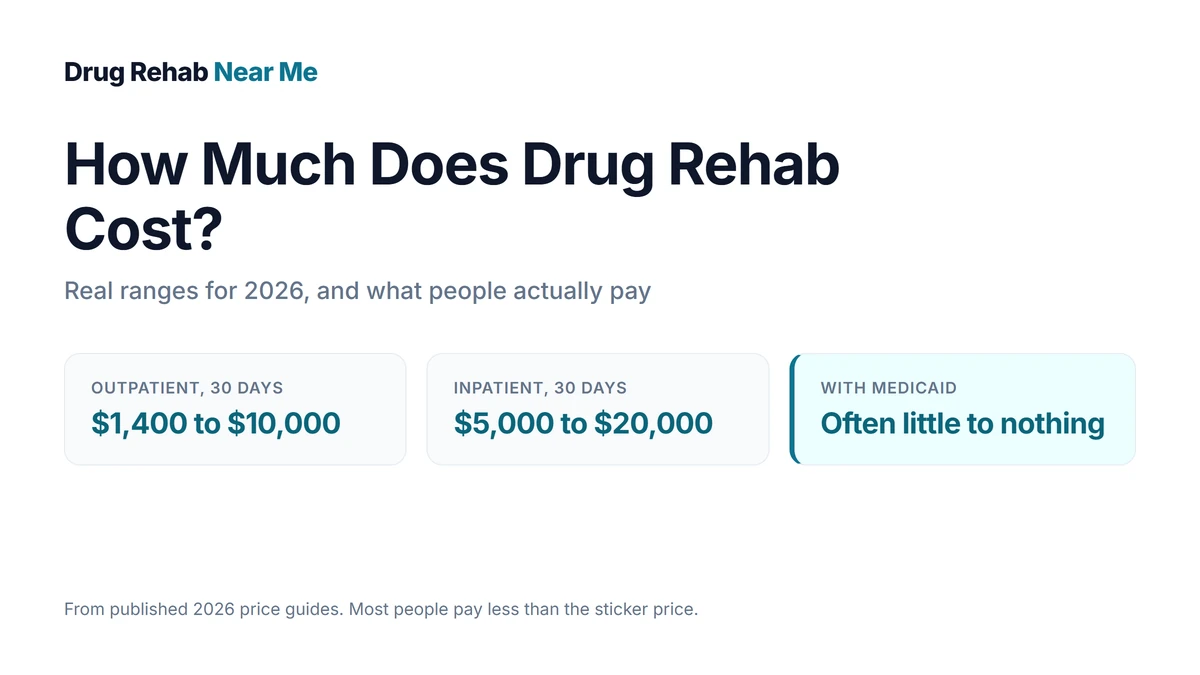
Drug rehab in the US typically runs $1,400 to $10,000 for a 30 day outpatient program and $5,000 to $20,000 for a 30 day inpatient stay, based on published 2026 price guides. Averaged across all treatment types, research puts the cost near $13,000 to $13,500 per person per treatment episode. Most people pay far less than these sticker prices, because insurance, Medicaid, and income-based fees absorb much of the bill.
That last sentence is the part most cost guides skip. The big treatment brands tend to hide their prices behind "call for a quote", and the statistics sites bury the answer under fifty state tables. So this guide does two jobs: it gives you the real ranges for every level of care, and then it walks through how people actually pay, including what the numbers look like when you have no insurance at all.
One note before the breakdown. Costs vary a lot by program and by state, so treat every figure here as a range, not a quote. If you want to talk through your options with a person instead of a spreadsheet, you can call (888) 470-5244 any time. It is free and confidential.
Drug Rehab Costs by Type of Program
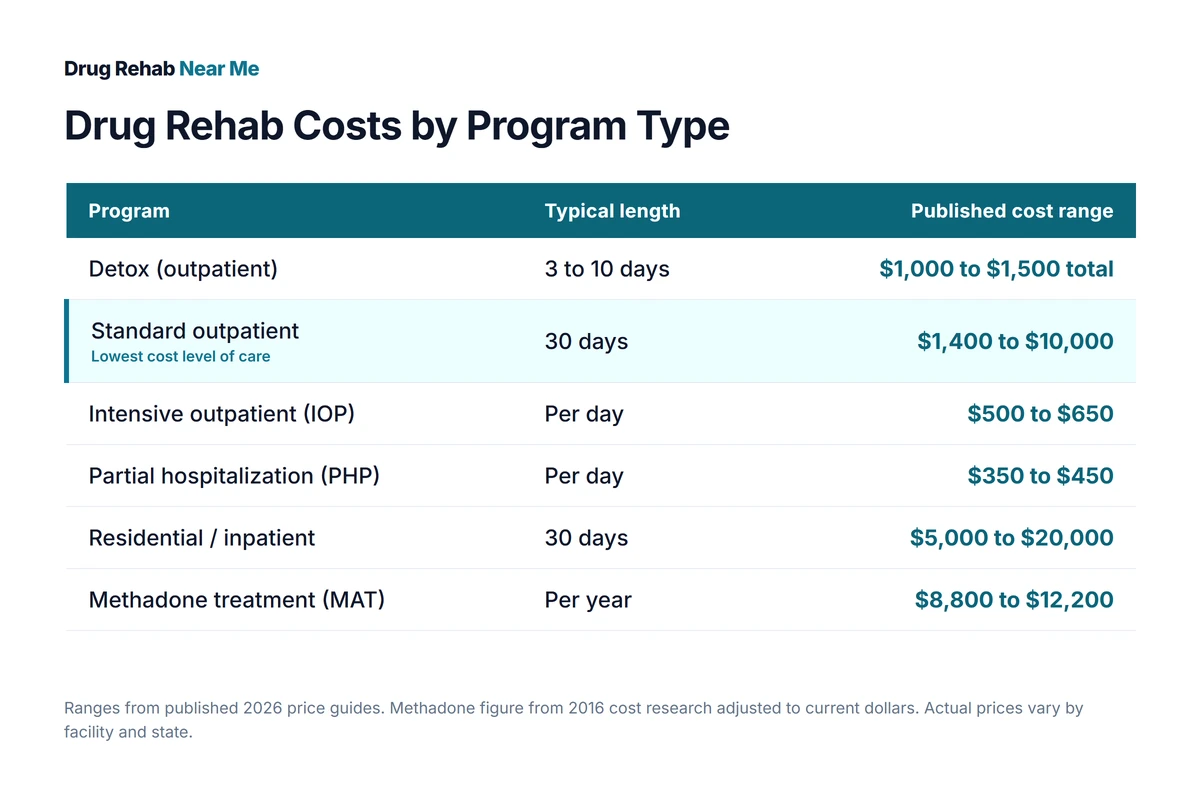
The level of care is the single biggest driver of price. Here is what each one is, and what published 2026 guides say it costs.
Detox
Medically supervised withdrawal, usually 3 to 10 days. Outpatient detox runs about $1,000 to $1,500 in total. If you go to an inpatient program, detox is usually bundled into the overall price rather than billed separately. Detox for alcohol, benzodiazepines, and opioids is the most medically involved, which pushes it toward the top of the range.
Standard outpatient
Counseling and group sessions a few hours a week while you live at home. This is the least expensive option: roughly $1,400 to $10,000 for a 30 day program, and around $5,000 for a three month program at many centers. It works best for milder substance problems and for people with strong support at home.
Intensive outpatient and partial hospitalization
Intensive outpatient programs (IOPs) meet 9 or more hours a week; published day rates run $500 to $650. Partial hospitalization programs (PHPs) are a step below inpatient, at $350 to $450 per day. A full IOP course often lands between $3,500 and $5,000. These middle tiers are popular because they cost a fraction of residential care while keeping most of the structure.
Residential and inpatient
You live at the facility with round-the-clock staff. A 30 day program typically costs $5,000 to $20,000, with well-known centers at the top of that range and beyond. Programs running 60 to 90 days scale up from there. If you are weighing this against outpatient care, the cost difference is real, but so is the difference in structure; our inpatient vs outpatient guide covers how to choose. You can also see what actually operates near you, for example inpatient programs in Texas or outpatient programs in California.
Luxury and executive programs
Private rooms, resort settings, low client counts. These are the programs behind the scary numbers you may have seen, and they can run several times the standard inpatient price. Nothing about a horse pasture or an ocean view is required for treatment to work.
Medication-assisted treatment
Methadone, buprenorphine, or naltrexone plus counseling, mostly for opioid and alcohol use disorders. Cost research from 2016, adjusted to current dollars, puts a year of methadone treatment at roughly $8,800 to $12,200. That sounds like a lot until you spread it across 365 days; it is one of the most studied and most cost-effective forms of addiction care.
What Changes the Price
Two programs with the same license can charge wildly different amounts. These are the factors doing the work:
- Level of care and length of stay. The two big ones. Every step up in supervision, and every added week, moves the bill more than any other factor.
- Location. A program in Malibu or Manhattan carries real estate and payroll costs that a program in a smaller city does not. State cost-of-living differences show up directly in price.
- Medical intensity. On-site physicians, nursing around the clock, and psychiatric care for co-occurring conditions all raise the rate.
- Amenities. Private rooms, chefs, gyms, and equine therapy are comfort, not clinical necessity. They can double a price tag.
- Medications. Programs that include medication-assisted treatment carry pharmacy and monitoring costs, though insurance frequently covers these.
- Who runs it. State-funded and nonprofit programs price to their funding, not to a profit margin. Private centers price to the market.
With Insurance: What You Actually Pay
With insurance, most people pay their plan's deductible plus a share of costs until they hit their out-of-pocket maximum, not the sticker price. For an in-network program, that usually means the real cost of a $20,000 stay is whatever your plan's out-of-pocket cap is, often somewhere between $1,500 and $9,000 depending on the plan.
Two laws matter here. The Affordable Care Act lists substance use disorder treatment as an essential health benefit, so marketplace and most employer plans must cover it at some level. And the federal parity law requires plans to cover addiction treatment no more restrictively than other medical care. Neither law makes treatment free, and coverage details vary by plan, so verify before anyone is admitted.
The worked example: say your plan has a $2,000 deductible, 20% coinsurance, and a $6,000 out-of-pocket max. On a $15,000 in-network inpatient stay, you would pay the $2,000 deductible, then 20% of remaining charges until your total hits $6,000. The plan pays the rest. Out of network, all of these numbers get worse, which is why the in-network question is the first one to ask.
Medicare and Medicaid both cover addiction treatment within their own rules. The details are their own topic, and our guide to insurance coverage for rehab walks through all of it, including how to verify benefits in one phone call.
No Insurance? The Realistic Playbook
Without insurance, the cash prices above are the starting point: roughly $1,400 to $10,000 for a month of outpatient care and $5,000 to $20,000 for a month of inpatient care. But the sticker price is negotiable more often than people expect, and the federal government publishes data that proves it.
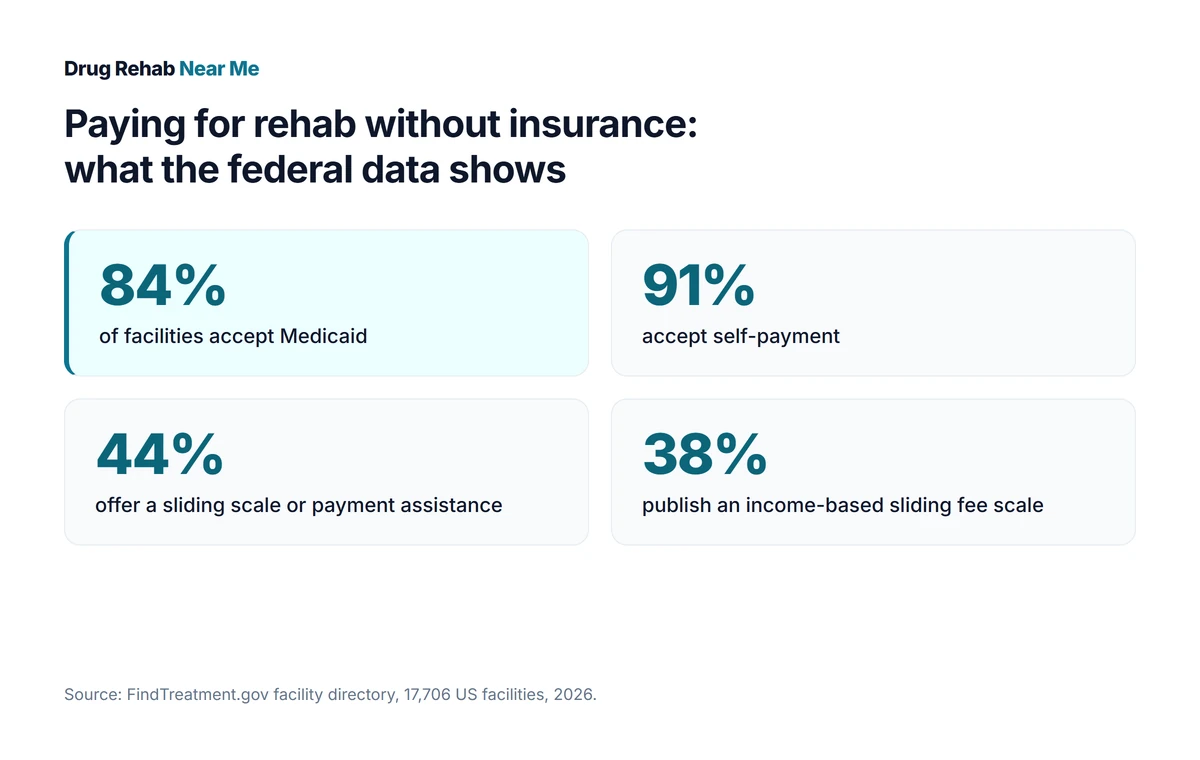
We checked the federal FindTreatment.gov facility directory, which listed 17,706 US treatment facilities as of 2026. Of those, 84% accept Medicaid, 38% publish a sliding fee scale that sets your price based on income, and 44% offer either a sliding scale or some form of payment assistance. And 91% accept self-payment, which means they set their own cash prices and many will negotiate them.
In priority order, this is the playbook:
- Check Medicaid first. If your income qualifies, Medicaid can bring treatment costs near zero, and 84% of facilities take it. Enrollment is year-round, and many programs will help you apply as part of intake.
- Ask every program for its sliding scale number. Not whether they have one. Say: "I have no insurance and my income is X. What would my actual cost be on your sliding scale?" More than a third of US facilities have an answer to that question.
- Ask about state-funded beds. Every state funds treatment slots for residents who cannot pay, usually through the same facilities you would call anyway. There may be a waitlist; get on it while you pursue other options.
- Ask about payment plans. Many self-pay programs will spread the cost over months rather than lose a client who wants help.
- Mention hardship directly. Federal block grant money flows to facilities specifically to cover people who cannot pay. The person on the phone knows whether their program has it. You have to ask.
Every facility listing on this site shows which of these payment options the facility reports to the federal directory, so you can filter for Medicaid or sliding scale programs before you ever pick up the phone.
Free and Low-Cost Rehab
Yes, free rehab exists. State-funded programs, some nonprofits, and faith-based organizations treat people at no cost when they qualify, usually based on income, state residency, and lack of insurance. The trade-offs are honest ones: waitlists are common, facilities are plainer, and you may have fewer choices about location and schedule. The care itself follows the same evidence-based approaches paid programs use.
The federal routes are the place to start. The SAMHSA National Helpline (1-800-662-4357) is free, confidential, and open around the clock, and FindTreatment.gov is the government's own directory. You can also browse programs by state right here, for example in Texas, California, Florida, or New York, and look for listings that show Medicaid or payment assistance.
Is Rehab Worth the Money?
It is a fair question when the number on the table is five figures. Here is the honest math. Addiction has its own price: one published 2026 guide estimates that a 12-pack-a-day drinking habit alone tops $3,000 a year, before a single missed paycheck, DUI, medical bill, or legal fee. Heavier drug habits cost multiples of that. Untreated addiction does not hold steady; the costs compound.
Treatment is not a guarantee. Recovery often takes more than one attempt, and no honest program promises a cure. But treatment works for many people, and even partial progress (fewer crises, kept jobs, restored health) pays for itself in ways a price tag misses. The genuinely bad financial decision is walking away from help because of a sticker price you were never actually going to pay, when sliding scales and Medicaid exist precisely for this situation.
How to Find Out What Rehab Costs Near You
National ranges only get you so far, because almost no program publishes its prices. The real number comes from asking. When you call a facility, these six questions get you to it fast:
- Are you in-network with my insurance? If so, what is my estimated out-of-pocket cost?
- If I have no insurance: what is your self-pay rate, and do you offer a sliding fee scale?
- What does that price include? (Detox, medications, therapy, aftercare, or are those billed separately?)
- Do you offer payment plans, and what do they look like?
- Do you have state-funded or grant-funded slots, and how does the waitlist work?
- What happens to the price if my stay needs to be extended?

From here you have two good moves. Browse the directory for your state and shortlist programs whose listed payment options match your situation. Or call (888) 470-5244 and talk it through with someone first; the line is free, confidential, and open 24/7, and it exists for exactly this conversation. Drug Rehab Near Me is an informational directory and referral service, not a treatment provider, and calling costs nothing and commits you to nothing.
One thing matters more than any of it: if you or someone you love is in immediate danger, call 911. If you are thinking about suicide or are in emotional crisis, call or text 988. Cost questions can wait until everyone is safe.
Frequently Asked Questions
How much does rehab cost without insurance?
Cash prices run roughly $1,400 to $10,000 for a 30 day outpatient program and $5,000 to $20,000 for a 30 day inpatient stay, per 2026 price guides. Federal directory data from 2026 shows 38% of US facilities offer a sliding fee scale based on income, so your real cost can be far lower. Always ask for the sliding scale number before ruling a program out.
How much does a 30 day rehab program cost?
A 30 day inpatient program typically costs $5,000 to $20,000, while a 30 day outpatient program runs $1,400 to $10,000. Where a program lands in that range depends mostly on location, medical intensity, and amenities.
Does insurance cover drug rehab?
Most plans cover addiction treatment because federal law treats it as an essential health benefit, and parity rules require coverage comparable to other medical care. What you pay depends on your deductible, coinsurance, and out-of-pocket maximum. Our insurance guide explains how to verify your benefits in one call.
Does Medicaid pay for rehab?
Yes. Medicaid covers substance use treatment in every state, and 84% of the 17,706 facilities in the 2026 federal directory accept it. If you qualify for Medicaid, it is usually the cheapest path into treatment, often at little to no cost.
Is rehab ever free?
Yes. State-funded programs, certain nonprofits, and faith-based organizations offer no-cost treatment for people who qualify, typically based on income and insurance status. Expect possible waitlists and simpler facilities, not lower-quality care.
Is outpatient rehab cheaper than inpatient?
Almost always. Outpatient care costs a fraction of inpatient care because you are not paying for housing and 24-hour staffing. Whether it is the right level of care is a separate question that depends on the severity of the addiction and your support at home.
Free & confidential, 24/7
Not sure which program fits? Talk it through with someone who can help.