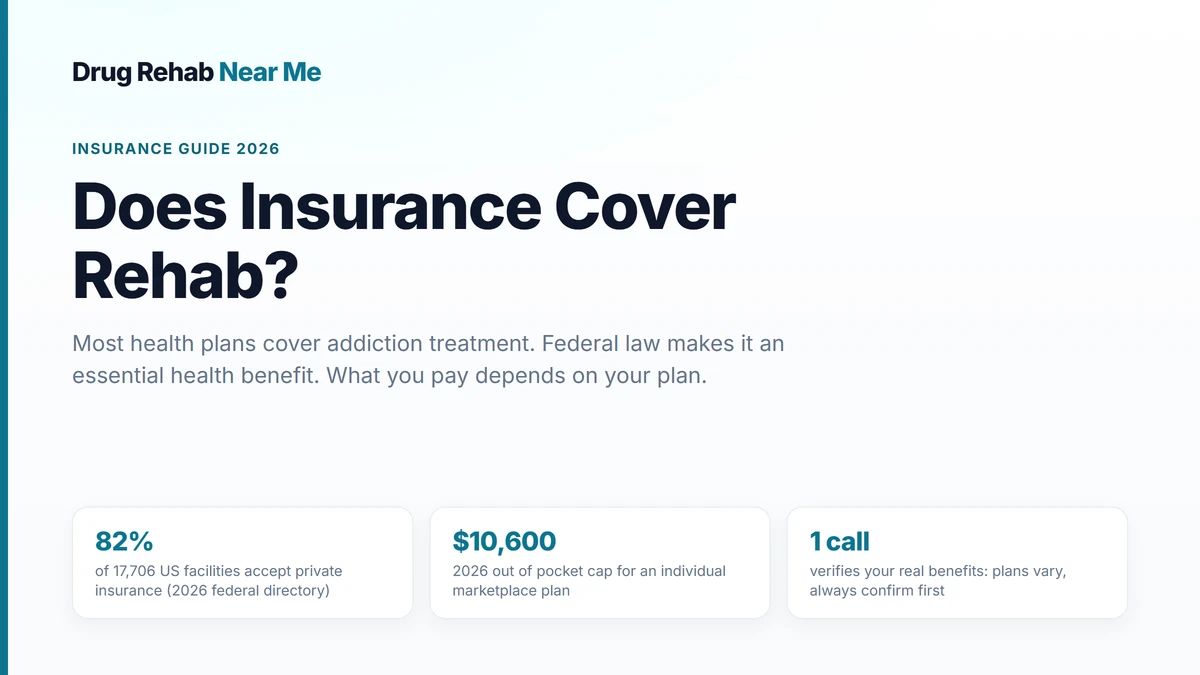
Yes, most health insurance covers rehab. Federal law lists substance use disorder treatment as one of the ten essential health benefits, which means marketplace plans and most employer plans must cover addiction treatment the same way they cover other medical care. What your specific plan pays depends on your deductible, your network, and whether the program gets authorized, so the real question is not whether insurance covers rehab but how much of it yours will.
That second question is the one this guide answers. The pages that rank for it are mostly written by treatment centers that want your admission, and their answer to every coverage question ends with their own phone number. We run a directory, not a facility, so we can walk you through the law, the numbers, and the exact verification call without pretending your plan's answer is already known. It is not. Plans vary, and anyone who promises coverage before checking your benefits is guessing.
Here is what the law requires, what each level of care usually looks like to an insurer, the three numbers that decide your cost, and the ten minute phone call that gets you a real answer.
What the Law Requires Health Plans to Cover
Two federal laws do the heavy lifting. The Affordable Care Act makes substance use disorder treatment an essential health benefit, so every marketplace plan must cover it, and most employer coverage follows the same rules. The Mental Health Parity and Addiction Equity Act adds the second half: plans cannot restrict addiction treatment more tightly than they restrict medical or surgical care. If your plan covers 30 days in a hospital for a heart condition, it cannot cap addiction care at some token amount instead.
Three protections matter in practice, and all three are current as of the 2026 plan year per HealthCare.gov:
- Plans cannot deny you or charge you more because addiction is a pre-existing condition. Coverage applies from the day the plan starts.
- Plans cannot put annual or lifetime dollar limits on essential health benefits, and substance use treatment is one of them.
- Parity applies to the fine print too: visit limits, prior authorization rules, and cost sharing for addiction care cannot be more restrictive than the plan's medical rules.
The honest exceptions: short-term health plans and a shrinking number of grandfathered plans do not have to follow these rules, and coverage details still differ plan to plan even where the law applies. That is why verification, not the law alone, gives you your answer.
Is Rehab Covered by Insurance at Every Level of Care?
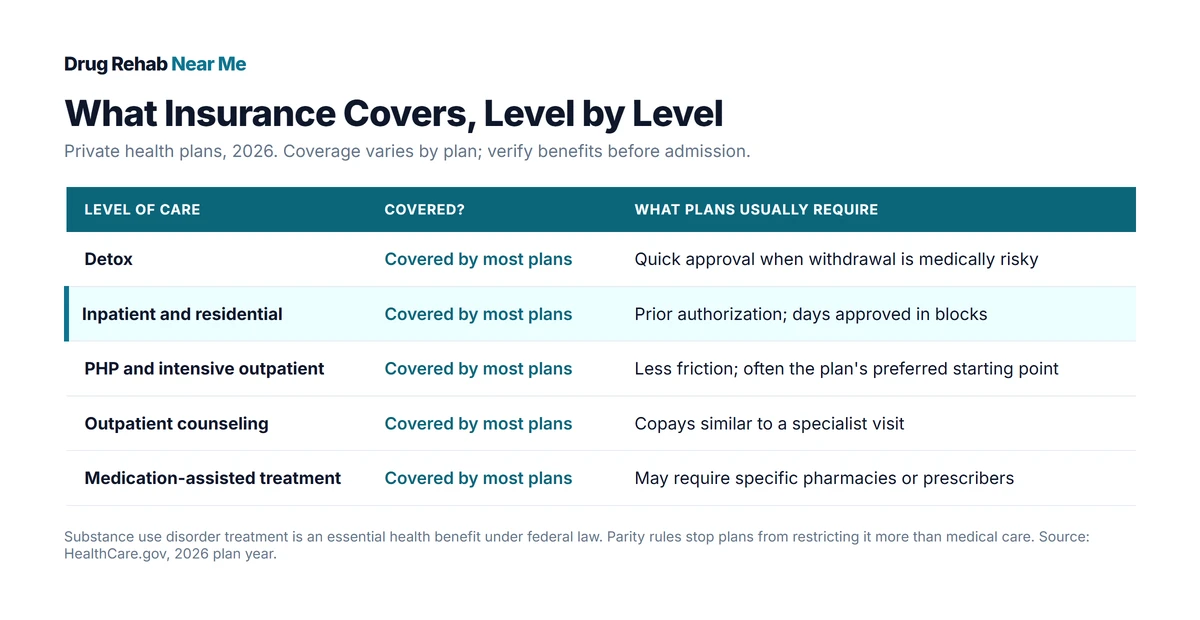
Insurance covers the full range of addiction treatment, from detox through outpatient counseling, when the plan agrees the level of care is medically necessary. Coverage applies to alcohol and drug treatment alike. The difference between levels is mostly how much scrutiny the insurer applies before saying yes.
Detox
Medically supervised withdrawal is usually covered, and often approved quickly because the medical need is easy to demonstrate, especially for alcohol, benzodiazepine, and opioid withdrawal. Plans may steer you toward outpatient detox when it is safe, and reserve inpatient detox for higher-risk cases.
Inpatient and residential treatment
Covered by most plans, but this is where prior authorization lives. Expect the insurer to ask for evidence that round-the-clock care is medically necessary, and to approve the stay in blocks rather than all at once. More on how to handle that below.
Outpatient care, IOPs, and partial hospitalization
Standard outpatient counseling, intensive outpatient programs, and partial hospitalization sit lower on the cost ladder, and insurers generally approve them with less friction. Many plans actively prefer them as the starting point. If you are new to the treatment ladder, our guide to what rehab actually is explains each level in plain language.
Medications and mental health care
Medication-assisted treatment (methadone, buprenorphine, naltrexone) is covered by most plans, though some require you to use specific pharmacies or prescribers. Therapy for co-occurring conditions like depression or anxiety is covered under the same parity rules, which matters because the two so often travel together.
How likely is a facility to take your plan? We checked the federal FindTreatment.gov directory, which listed 17,706 US treatment facilities as of 2026: 82% of them accept private health insurance. Acceptance is the norm, not the exception. Whether a specific facility is in your plan's network is a separate question, and it is the single most expensive detail to get wrong.
The Three Numbers That Decide What You Pay
Once coverage is confirmed, your cost comes down to three numbers printed in your plan documents.
- Deductible. What you pay out of pocket each year before the plan starts sharing costs.
- Coinsurance or copay. Your share after the deductible, often 10% to 30% of each bill for in-network care.
- Out-of-pocket maximum. The annual ceiling on what you can be charged for covered, in-network care. For 2026, federal rules cap this at $10,600 for an individual and $21,200 for a family on marketplace plans; many employer plans set lower caps.
Here is the worked example. Say your plan has a $2,500 deductible, 20% coinsurance, and a $7,000 out-of-pocket maximum, and you are admitted to an in-network residential program billed at $15,000. You pay the $2,500 deductible, then 20% of the remaining $12,500, which is another $2,500. Your total is $5,000, under your cap, and the plan pays the other $10,000. If you had already met part of your deductible earlier in the year, you would pay less.
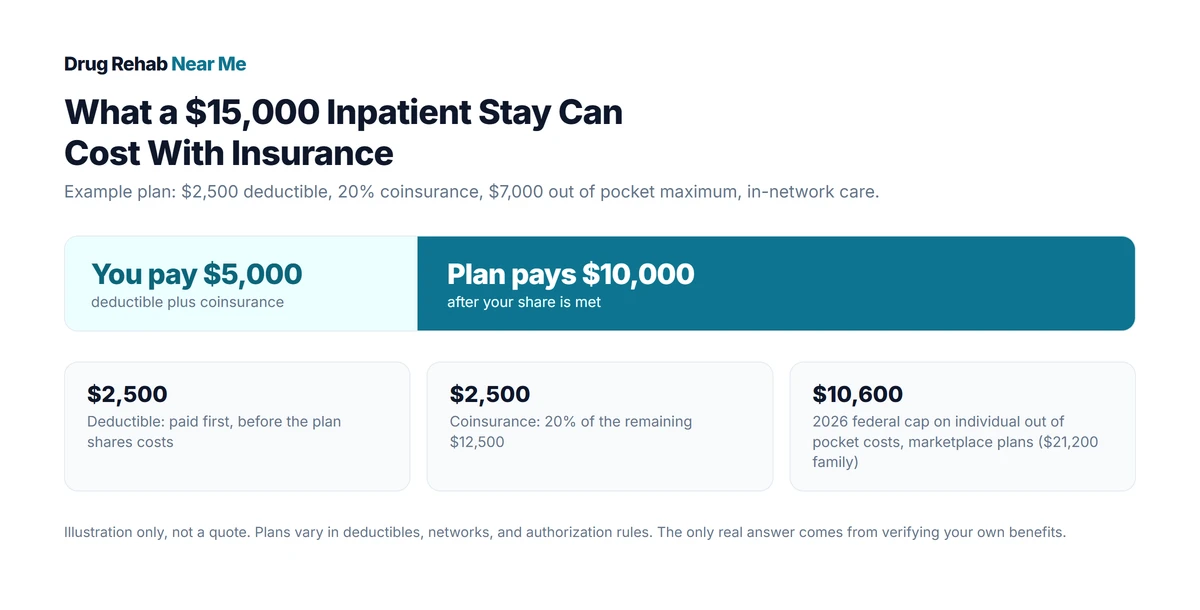
Now the same stay out of network: a plan might cover 50% instead of 80%, apply a separate and higher deductible, and out-of-network charges often do not count toward your in-network out-of-pocket cap at all. The in-network question is worth thousands of dollars. Ask it first, every time.
For what programs actually charge before insurance, from free state-funded beds to luxury residential, see our guide to rehab costs. This page stays focused on what your plan does to those numbers.
Does Insurance Cover Inpatient Rehab?
Yes, most private health plans cover inpatient rehab when it is medically necessary, and federal parity rules prevent plans from restricting it more than comparable medical care. The catch is process: nearly every plan requires prior authorization before admission, and approvals usually come in blocks of days rather than a full stay at once.
Three terms explain most of what happens next. Prior authorization means the insurer signs off before treatment starts. Medical necessity is the standard they apply, usually based on published criteria that weigh withdrawal risk, previous treatment attempts, home environment, and co-occurring conditions. Concurrent review means the insurer keeps checking during the stay, approving more days as the clinical picture justifies them. This is why someone can be approved for 7 days at a time inside what becomes a 30 day stay. Our guide to how long rehab lasts covers what those lengths look like clinically.
To get insurance to pay for inpatient rehab, the sequence that works looks like this:
- Call the number on your insurance card and confirm inpatient substance use treatment is a covered benefit on your plan.
- Get an assessment from a licensed clinician or the facility's admissions team; this creates the medical necessity documentation the insurer needs.
- Let the facility run the prior authorization. Admissions departments do this daily and know what each insurer wants to see.
- Confirm the facility is in-network before you commit, not after.
- If the insurer approves a lower level of care instead, you can accept it or appeal; an approval for an IOP is not a denial of help.
Facilities themselves are easy to compare by state and program type, for example inpatient programs in Texas or outpatient programs in California.
Plan Types, and Where Medicaid and Medicare Fit
The letters on your insurance card change the mechanics. An HMO usually covers only in-network care and may want a referral first. A PPO covers out-of-network care at a worse rate and skips referrals. An EPO is the strict middle: no referrals needed, but no out-of-network coverage either. Employer plans and marketplace plans both follow the essential health benefit rules; short-term plans are the ones to watch, because they can exclude addiction treatment entirely.
Public programs cover treatment too, under their own rules. In the 2026 federal directory data, 82% of facilities accept Medicaid and 60% accept Medicare, and TRICARE is accepted at 48% of facilities for military families. Medicaid eligibility and covered services vary by state, so check your state program directly. This guide, and the verification steps below, focus on private insurance, which is where most of the confusing fine print lives.
If your coverage is through a specific carrier, we keep plain-language guides for the big ones: see does Cigna cover rehab and does Aetna cover rehab.
How to Verify Your Rehab Benefits in One Call
Ten minutes on the phone replaces every guess in this article with your plan's actual answer. Grab your insurance card and call the member services number on the back. Ask these questions, in this order, and write the answers down:
- Is substance use disorder treatment a covered benefit on my plan?
- Which levels of care are covered: detox, inpatient, partial hospitalization, IOP, outpatient?
- Do any of them require prior authorization, and who starts that process?
- What is my deductible, how much of it have I met, and what is my coinsurance for each level of care?
- What is my out-of-pocket maximum, and how much of it have I already used this year?
- Do I have out-of-network benefits, and how do they differ?
- Is there a specific network or list of approved facilities you can send me?
- Can I have a reference number for this call, and your name?

That last line matters more than it looks. If a claim gets disputed later, "on August 12 your representative Dana, reference 4471, confirmed coverage" is worth more than any memory of the conversation.
If you would rather talk it through with a person first, call (888) 470-5244. It is free and confidential, and the whole point of the line is to help you sort out what your options look like, including what to ask your insurer. You can also browse facility listings on this site, each of which shows the payment types the facility reports to the federal directory, so you can shortlist programs that take private insurance before making a single call. Drug Rehab Near Me is an informational directory and referral service, not a treatment provider or an insurance company, and nothing here is a promise of coverage. Your plan's verified answer is the only one that counts.
If Your Plan Says No
Denials happen, and they are not the end of the road. Every plan must offer an internal appeal, where a different reviewer looks at the decision, and federal rules give you the right to an external review by an independent third party after that. Facilities deal with denials constantly; ask their admissions team to help with the paperwork, because a denial overturned on appeal costs them nothing and gains you everything.
If the denial smells like the plan treating addiction care more harshly than medical care, that is a parity issue, and your state insurance regulator takes those complaints. And while an appeal runs, you still have moves: sliding fee scales, payment plans, and self-pay negotiation are all real, and our rehab cost guide walks through each one with the federal data on which facilities offer them.
One thing outranks every coverage question: if you or someone you love is in immediate danger, call 911. If you are thinking about suicide or are in emotional crisis, call or text 988. Insurance can wait until everyone is safe.
Frequently Asked Questions
Does insurance pay for rehab directly, or do I pay and get reimbursed?
For in-network care, the facility bills your insurer directly and you pay only your share, usually at admission or after. Out-of-network care sometimes works on reimbursement, where you pay upfront and file a claim. Confirm which way it runs before admission day so the first bill is not a surprise.
How many times will insurance pay for rehab?
There is no legal limit on the number of times. Plans cannot put annual or lifetime dollar caps on essential health benefits, and parity rules block addiction-only visit limits. Each new treatment episode still has to pass the medical necessity review, so expect the insurer to look harder at the clinical justification each time.
Does insurance cover outpatient rehab?
Yes, and usually with less friction than inpatient care. Outpatient counseling, IOPs, and partial hospitalization all fall under the same essential health benefit, and many plans prefer to approve them first because they cost less. Copays for outpatient care often mirror your plan's regular specialist visit cost.
Does insurance cover rehab for alcohol?
Yes. Alcohol use disorder is a substance use disorder, and plans cover its treatment under the same essential health benefit and parity rules as drug treatment. Detox, residential care, outpatient programs, and medications like naltrexone all qualify when medically necessary.
Can you go to rehab without insurance?
Yes. In the 2026 federal directory, 91% of facilities accept self-payment, 38% offer income-based sliding fee scales, and state-funded programs treat people who cannot pay. Our cost guide covers the no-insurance playbook step by step.
How much does rehab cost with insurance?
For in-network care, your cost is your deductible plus coinsurance, capped by your out-of-pocket maximum, which for 2026 marketplace plans cannot exceed $10,600 for an individual. Depending on the plan and how much of the deductible you have met, a stay billed at $15,000 might cost you anywhere from a few hundred dollars to several thousand, which is exactly why the verification call comes first.
Free & confidential, 24/7
Not sure which program fits? Talk it through with someone who can help.