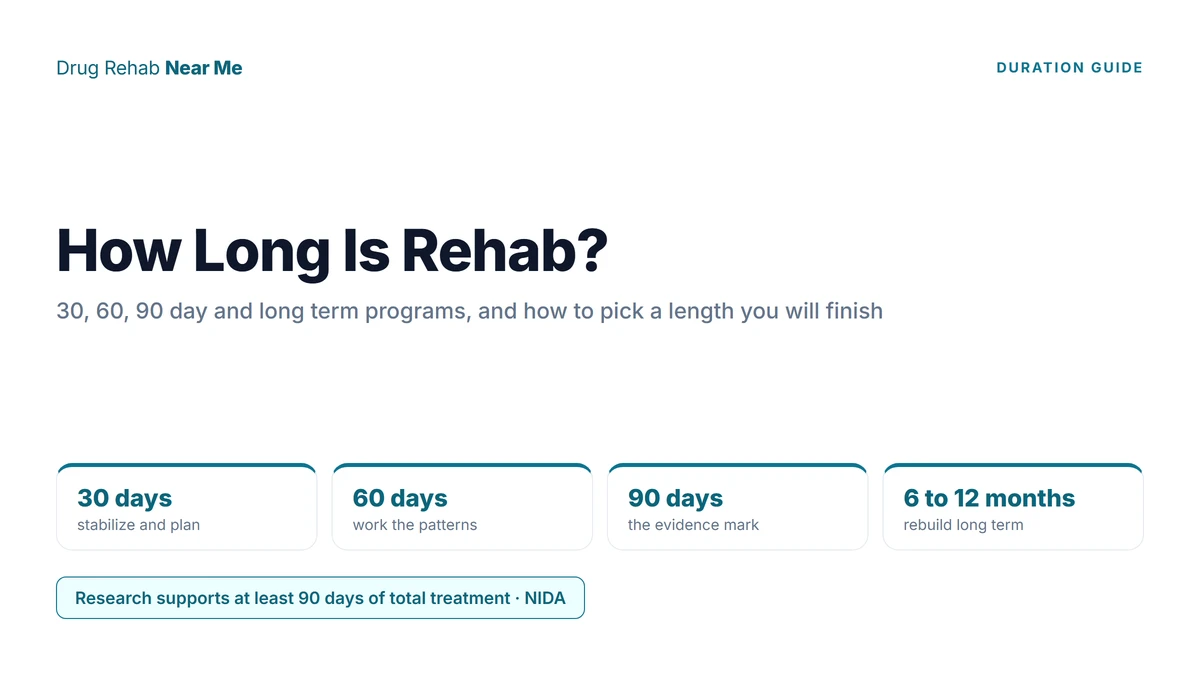
Most drug and alcohol rehab programs run 30, 60, or 90 days, with outpatient care often continuing for several months at a lower intensity. Research published by the National Institute on Drug Abuse finds that less than 90 days of treatment tends to have limited effect, so many people assemble those 90 days across levels of care, for example 30 days in a residential program followed by two months of outpatient sessions. How long is rehab for you specifically? That depends on the severity of the addiction, your insurance, and your life; this guide breaks down what each length can realistically do.
Two things before the details. The calendar matters less than finishing, and if you want to talk through what a given length would look like in your situation, (888) 470-5244 is free, confidential, and staffed around the clock.
The Standard Program Lengths
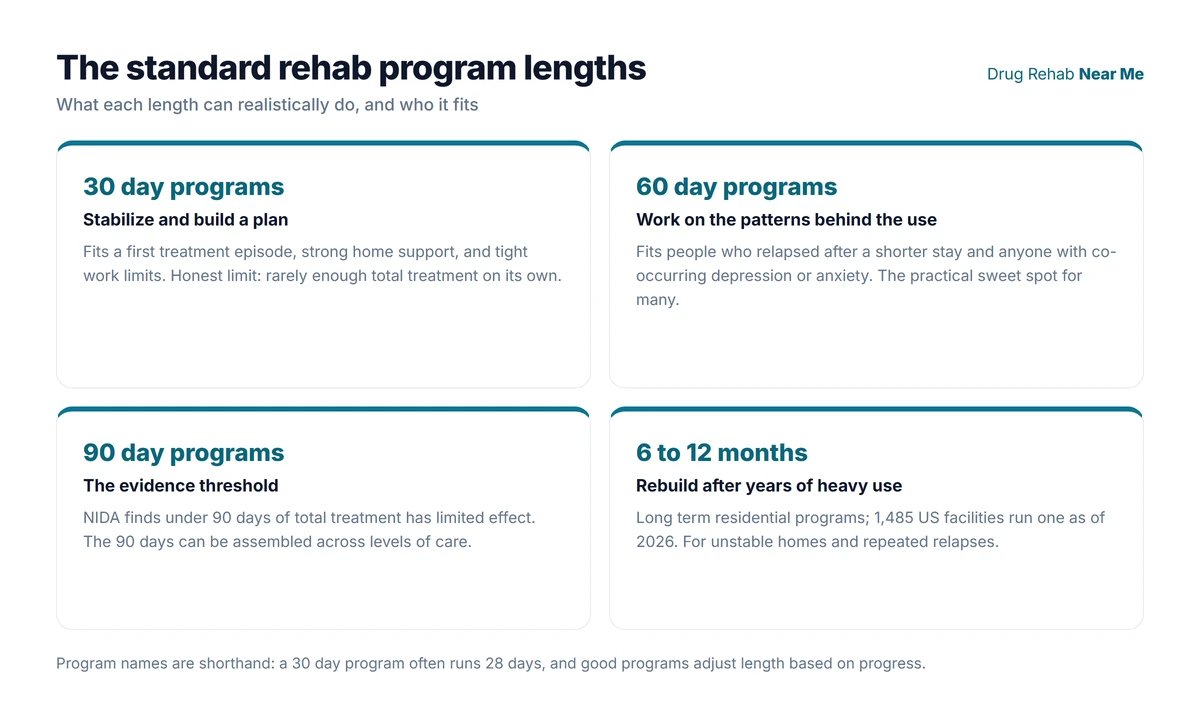
Treatment programs are usually sold in four rough shapes. One caution before the breakdown: the names are marketing shorthand, not contracts. A "30 day program" often runs 28 days, a "90 day program" averages about three months, and programs routinely extend or shorten a stay based on how someone is actually doing. Here is what each length is genuinely for.
30 day programs
A month of treatment is the classic starting point, and it is popular for practical reasons: it is the easiest length to get approved by insurance, the easiest absence to explain at work, and the least intimidating commitment when someone is on the fence. Thirty days is usually enough to get stable, learn the basics of relapse prevention, and build a plan. What it usually is not, on its own, is enough total treatment. Programs know this, which is why a good 30 day stay ends with a step-down plan rather than a goodbye.
60 day programs
Two months buys what one month cannot: time to work on the reasons behind the substance use, not just the stopping. People who have relapsed after a shorter program, or who have a co-occurring condition like depression or anxiety, often land here. It is the compromise length, and for many people it is the practical sweet spot between clinical benefit and real life. Sixty days also changes what therapy can do: the first month is often spent getting steady, and the second is where patterns actually get worked on. If a 30 day stay felt like it ended right as it started working, that experience is the argument for this tier.
90 day programs
Three months is the length the evidence keeps pointing at. The National Institute on Drug Abuse's published treatment principles conclude that stays under 90 days have limited effectiveness, and that longer participation predicts better results. The 90 days do not have to happen inside one building; a residential month followed by intensive outpatient care counts. If you can arrange a true 90 day program, options like the long term programs in Florida show what that looks like in practice.
Six months to a year and beyond
Long term residential programs run 6 to 12 months, sometimes more. They exist for people rebuilding from years of heavy use, people whose home environment would sink a shorter stay, and people coming out of repeated relapses. They are more available than most people assume: the federal FindTreatment.gov directory lists 1,485 US facilities running long term residential programs as of 2026. Browse long term rehab in Texas or long term rehab in California to see real examples.
How Long Each Level of Care Lasts
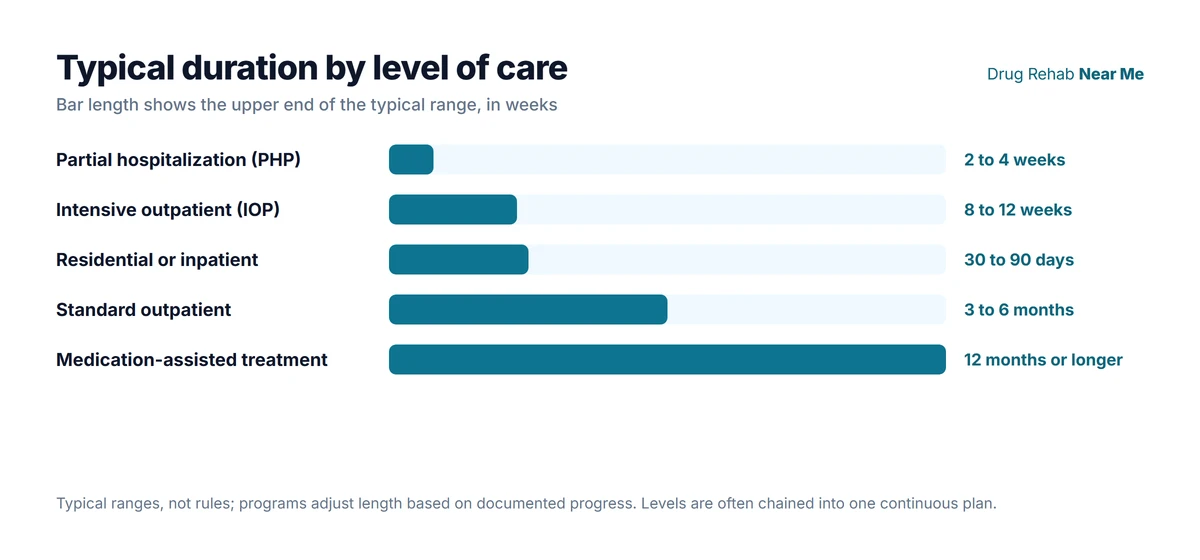
Program length and level of care are two different dials. A 60 day plan might mean two months at one outpatient clinic, or a residential month followed by a month of day treatment. Each level has typical runtimes of its own, and good programs chain them into one continuous plan:
- Detox: if your body is physically dependent, treatment may start with a short, medically supervised detox before therapy begins; the program you contact will tell you whether you need it.
- Residential and inpatient: typically 30 to 90 days of living at the facility.
- Partial hospitalization (PHP): usually 2 to 4 weeks of roughly 6 hour treatment days while sleeping at home.
- Intensive outpatient (IOP): commonly 8 to 12 weeks at around 9 hours of treatment a week.
- Standard outpatient: a few hours a week, often continuing for 3 to 6 months or as long as it keeps helping.
- Medication-assisted treatment: for opioid and alcohol use disorders, medication often continues 12 months or longer, alongside any of the levels above.
If those labels are new, our guide to what rehab is and how it works explains each level properly, and the inpatient vs outpatient comparison helps you pick a side. To see real inpatient stays near you, start with inpatient programs in Ohio or inpatient programs in New York.
How Long Is Rehab for Alcohol?
Alcohol rehab typically lasts 30 to 90 days, the same range as treatment for any other substance, with outpatient support often continuing for months afterward. The same evidence about longer treatment applies. Two things tend to stretch alcohol timelines specifically. First, heavy long-term drinking usually needs medical supervision at the start, which adds a stabilization period before the therapy clock really starts. Second, alcohol is legal, cheap, and everywhere, so relapse prevention work tends to need more reps before it holds; many clinicians steer long-time drinkers toward 60 or 90 days of total treatment rather than a single month.
Medication is also part of many alcohol recovery plans, and prescriptions like naltrexone or acamprosate often continue for months after a program ends. That is maintenance, not failure; nobody counts blood pressure medication against a heart patient.
How Long Is Drug Rehab?
Drug rehab runs 30 to 90 days for most people, but the substance changes the shape of the plan more than people expect. Opioid treatment is frequently paired with medication (methadone, buprenorphine, or naltrexone) that continues for a year or longer, so the meaningful answer is "a program measured in weeks, plus support measured in months". Stimulants like methamphetamine and cocaine have no approved treatment medication, which puts the full weight on behavioral therapy and generally argues for longer program participation; our meth addiction treatment guide and cocaine addiction treatment guide cover those specifics. Whatever the substance, the 30, 60, and 90 day structures are the containers; severity, not the drug's name alone, sets the dial.
What Actually Decides Your Length of Stay
Program brochures list lengths like set menus, but four things actually determine how long you stay:
- Severity and history. Years of use, amounts, previous treatment attempts, and any co-occurring mental health conditions all push toward longer plans.
- Your home environment. A stable, supportive household makes shorter residential stays workable. A house full of active use does the opposite, and clinicians weigh this heavily.
- Insurance authorization. Here is the part nobody explains: insurers rarely approve 90 days upfront. They authorize treatment in review cycles, often one or two weeks at a time, extending coverage as the program documents medical necessity and progress. Your stay is built in installments, which is normal and manageable; our insurance guide explains how to navigate it.
- Court requirements. If treatment is court ordered, the order sets a minimum, commonly 30 to 90 days, and completion is reported back to the court.
Notice what is not on the list: a fixed number that applies to everyone. Good programs adjust length based on progress, not the brochure.
Why Longer Usually Beats Shorter (and When It Does Not)
The research case for longer treatment is genuinely strong, and it is worth being precise about what it says. Time in treatment predicts better outcomes; under 90 days of total participation tends to underdeliver. What the research does not say is that the 90 days must happen away from home, or that a longer stay helps someone who has mentally checked out. Longer only wins when the person stays engaged.
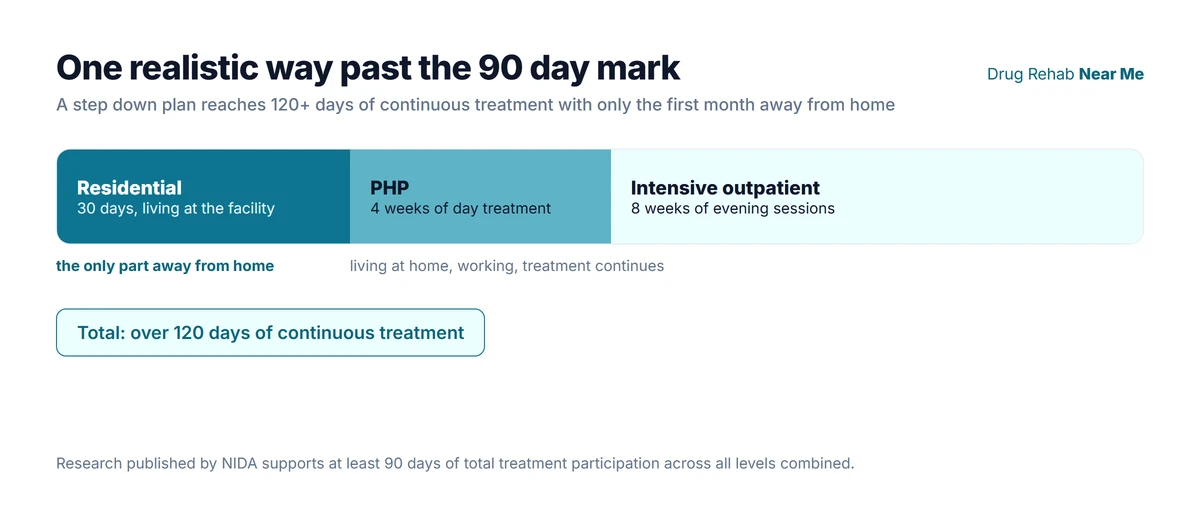
The honest version for people with jobs, kids, and rent: a step-down plan is how most people actually reach 90 days of treatment without 90 days of absence. A common version looks like this: 30 days residential, then 4 weeks of partial hospitalization while living at home, then 8 weeks of intensive outpatient in the evenings. That is over 120 days of continuous treatment, and only the first month required being away. And if long term residential care is what your situation genuinely calls for, availability is better than assumed: 72% of US facilities with residential programs run a long term track as of the 2026 federal directory.
Time, Money, and Your Job
Duration is also a budget question. Cost scales roughly with length and level of care; published 2026 ranges run $5,000 to $20,000 for a 30 day inpatient stay and far less for outpatient formats, with the full breakdown in our rehab cost guide. Insurance covers medically necessary treatment under federal parity rules, but as described above, it approves length in cycles rather than upfront.
Work is the other constraint. Many people qualify for job-protected medical leave under FMLA while in treatment, and employers with 50 or more employees are commonly covered; the details, including what your employer can and cannot ask, are in our rehab and job protection guide.
Choosing a Length You Will Actually Finish
Here is the rule that beats every chart on this page: the best program length is the longest one you will actually complete. A finished 30 day program with a strong step-down plan beats an abandoned 90 day one, every time.
If you are weighing options, two good moves. Call (888) 470-5244 and talk through what 30, 60, or 90 days would look like around your job, family, and insurance; the line is free, confidential, and open 24/7. Or browse the directory and filter by what you need, for example residential programs in Pennsylvania, where each listing shows the levels of care and payment options the facility reports to the federal government. Drug Rehab Near Me is an informational directory and referral service, not a treatment provider, and calling costs nothing.
And the one thing that outranks all planning: if you or someone near you is in immediate danger, call 911. If you are thinking about suicide or are in emotional crisis, call or text 988. Length-of-stay questions can wait until everyone is safe.
Frequently Asked Questions
How long does rehab last on average?
Most structured programs last 30 to 90 days, with outpatient care commonly continuing for 3 to 6 months afterward. Research from the National Institute on Drug Abuse supports at least 90 days of total treatment participation across all levels of care combined.
Is 30 days in rehab enough?
For most people, 30 days is enough to stabilize and build a plan, but not enough total treatment on its own. It works best as the first block of a longer plan, stepping down into outpatient care that carries the total past the 90 day mark.
How long is inpatient rehab?
Inpatient and residential stays typically run 30 to 90 days, with long term residential programs extending 6 to 12 months. The right stay depends on severity, home environment, and how your insurance authorizes coverage.
How long is outpatient rehab?
Intensive outpatient programs commonly run 8 to 12 weeks, and standard outpatient counseling often continues 3 to 6 months or longer. Because you keep living at home, outpatient timelines flex around work and family in a way residential stays cannot.
How long is short term rehab?
In federal SAMHSA terminology, short term residential treatment means a stay of 30 days or fewer. The 2026 FindTreatment.gov directory lists 1,420 US facilities offering short term residential programs.
How long is court ordered rehab?
The court order sets the length, most often somewhere between 30 days and a year depending on the offense and the state's program. Completion is reported to the court, and leaving early can carry legal consequences, which makes it different from voluntary treatment.
Free & confidential, 24/7
Not sure which program fits? Talk it through with someone who can help.