
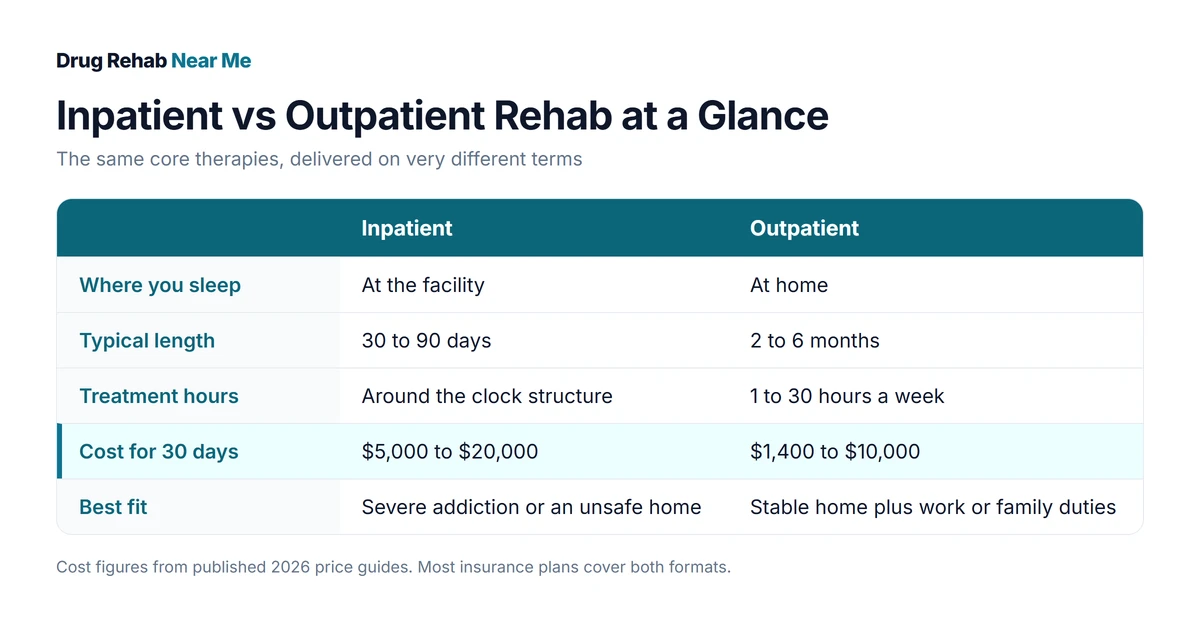
Inpatient rehab means living at a treatment facility while you get care, usually for 30 to 90 days, with staff on hand around the clock. Outpatient rehab means living at home and going to scheduled treatment sessions, anywhere from a couple of hours a week to nearly 30. That is the entire mechanical difference between inpatient vs outpatient rehab. The harder question is which one fits your life, and that depends on how severe the problem is, how safe your home is, and what your body needs. It does not depend on which program a website happens to be selling.
This guide is the honest version of that decision: what each format costs, what each one asks of your time, who genuinely needs 24 hour care, and who does better sleeping in their own bed. If you would rather think it through out loud with a person, you can call (888) 470-5244 any time. It is free and confidential.
Inpatient vs Outpatient Rehab: The Core Difference
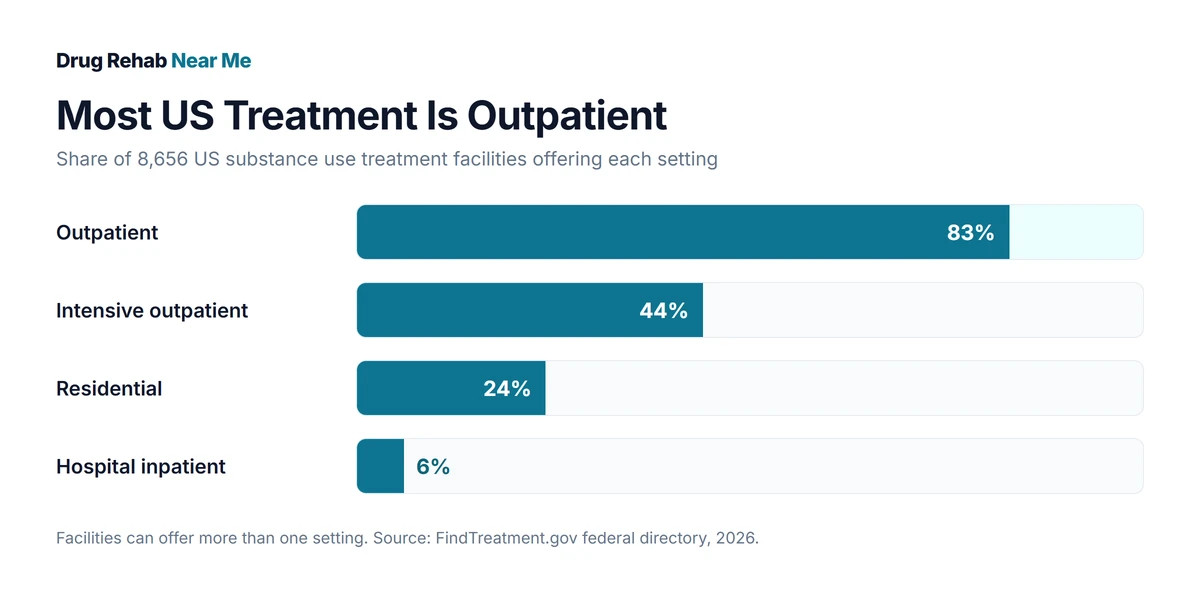
Inpatient treatment means you move in. You sleep at the facility, eat there, and follow a structured daily schedule of individual therapy, group sessions, and skills work, with clinical staff available at 3pm and at 3am alike. Strictly speaking, clinicians split this family in two: hospital inpatient care, which happens on a medical unit, and residential treatment, which happens in a live-in center that looks more like a dorm or a house. The distinction matters less than marketers suggest. In the federal treatment directory, only 6% of US substance use facilities offer hospital inpatient care at all, so when people say rehab, they almost always mean residential. In everyday use, inpatient covers both, and this guide uses it that way.
Outpatient treatment is not one program. It is a spectrum. Standard outpatient is an hour or three of counseling per week. Intensive outpatient programs (IOPs) run nine or more hours a week. Partial hospitalization programs (PHPs) can reach 30 hours a week, which is a full time job's worth of treatment while you still go home at night. The therapies inside are largely the same ones inpatient programs use: individual counseling, group therapy, family sessions, and medication management where appropriate.
If you want the full tour of every level of care, our guide to what rehab is and how it works walks through them all. This page is about choosing between the two big families.
Time: What Each One Asks of Your Life
Inpatient rehab takes over your calendar completely for 30 to 90 days, and treatment industry figures published in 2026 put the typical stay at 30 to 45 days. Outpatient rehab runs longer on the calendar, often two to six months and sometimes more, but it takes hours out of a week instead of weeks out of a year.
Here is the honest time math. An IOP typically meets about three hours a session, three to five days a week, scheduled in the early morning or evening so people can keep working. A PHP asks for five to six hours a day, most days of the week, which usually does mean stepping away from work for a stretch. Standard outpatient fits inside almost any schedule.
So the real trade is not long versus short. It is time away versus time carved out. A month in residential care can be less disruptive than a year of white-knuckling, but it is a month someone else covers your job, your kids, and your rent. Outpatient spreads the same work across your normal life, which is gentler on logistics and harder on discipline. The full breakdown of program lengths, and who each one fits, is in our guide to how long rehab lasts.
Cost: A Real Difference, Smaller Than the Sticker Price
Published 2026 price guides put a 30 day outpatient program at roughly $1,400 to $10,000 and a 30 day inpatient stay at $5,000 to $20,000. Inpatient costs more because you are paying for a bed, meals, and round the clock staffing on top of the same therapy hours. In between sit the intensive formats: published day rates run $500 to $650 for IOP sessions and $350 to $450 for PHP.
Before the sticker price scares you off, two things. First, federal law lists addiction treatment as an essential health benefit, so most insurance plans must cover it at some level, in both formats. Second, what an insured person actually pays is usually the plan's out-of-pocket cap, often somewhere between $1,500 and $9,000 for in-network care, not the list price. A $15,000 residential stay and a $4,000 IOP can land surprisingly close to each other once a deductible and coinsurance do their work.
The point is not that money does not matter. It is that you should not rule out the level of care you need based on a number nobody actually pays. Our rehab cost guide and insurance coverage guide take this apart properly, including what to do with no insurance at all.
Who Genuinely Needs Inpatient Care
Inpatient care is the right call when at least one of these is true:
- Stopping might not be medically safe where you live. If your body has become physically dependent, treatment may need to begin with medically supervised stabilization, and whether that applies to you is a clinician's call made during an intake assessment, not something to guess at alone.
- You have tried outpatient care and it has not held. A pattern of starting programs and slipping out of them is not a character flaw. It is information, and it points toward more structure, not another identical attempt.
- People drink or use in the place you live. The best therapy in the world struggles against a kitchen where someone else keeps a bottle. Distance is a legitimate clinical tool.
- You have a mental health condition that needs daily attention. Severe depression, unmanaged bipolar disorder, or active PTSD alongside heavy substance use often does better where clinicians can watch how treatment and mood interact day to day.
- You do not have stable housing. Outpatient treatment assumes there is a home base. When there is not one, a residential program provides the base and the treatment at once.
Notice what is not on that list: willpower. Choosing 24 hour care is not an admission of weakness. It is matching the intensity of treatment to the severity of the problem, the same way medicine handles every other serious condition. If several of those bullets described you, start your search with live-in programs, for example inpatient rehab in Texas or residential programs in Florida, and let an admissions assessment confirm the fit.
Who Does Better Living at Home
Outpatient care is not inpatient lite. For the right person it is simply the right treatment, and the profile looks like this:
- You have a job you need to keep. Outpatient schedules are built around work. And if you do eventually need time away, federal law protects treatment leave for many workers; our rehab and job protection guide explains FMLA and how to use it without torching your career.
- You are the caregiver. Parents of young kids and adults caring for aging parents often cannot disappear for six weeks. Outpatient treatment lets the household keep standing while you get well.
- Home is stable and sober. A partner who supports recovery and a house with no alcohol in it are genuine clinical assets. Treatment research keeps finding that environment does a lot of the work.
- The problem is milder or newer. Someone who caught a drinking pattern early needs a different dose of treatment than someone ten years into daily use. Lighter cases genuinely do well in lighter care.
- You can reliably show up. Outpatient care runs on your own transportation and your own follow-through. Both have to actually exist.

The option most people have never heard of sits in the middle. An IOP delivers nine or more treatment hours a week, evenings included, while you keep your job and your bed. It is also one of the most available formats in the country: 44% of US treatment facilities offered an IOP as of 2026. Browse outpatient programs in California or intensive outpatient programs in California to see how they describe themselves.
What the Federal Data Says About Availability
We analyzed the federal FindTreatment.gov directory, which lists 8,656 US facilities offering substance use treatment as of 2026. The shape of American treatment surprised us. 83% of those facilities offer outpatient care. Only 24% have residential beds, and 6% offer hospital inpatient care. Outpatient programs outnumber residential ones roughly 3.5 to 1, and just 726 facilities in the country offer both under one roof.
That has three practical consequences. Outpatient care is probably available close to your home, while a residential bed may mean traveling or waiting. Moving between levels usually means changing providers, so plan for the handoff rather than being surprised by it. And most of the comparison guides you will read online are published by residential providers, who are honest people with a bed to fill; keep that in mind when a quiz concludes you need their program.
We are a directory, not a treatment provider, and every listing on this site shows the levels of care each facility reports to that same federal dataset, state by state and city by city. The data does not care which option you pick.
Five Questions That Settle It
Strip away the marketing and the decision usually comes down to five questions:
- Is it medically safe for me to stop where I live? If you are not sure, that alone is a reason to talk to a professional before anything else. Intake assessments exist to answer exactly this.
- Have I tried outpatient before, and what actually happened? Be specific. One rough week is not the same as three programs that never stuck.
- Does my home help me or hurt me? Answer it about the house you live in, not the one you wish you lived in.
- What truly cannot be walked away from, and what can? Jobs have legal protections. Kids need a plan, not a hero. Write the list before assuming the answer is nothing.
- What will my plan cover, and what is my out-of-pocket cap? Get real numbers from your insurer before you rule anything out on cost.
You do not have to score this quiz alone. Call (888) 470-5244 and describe your situation, and a real person will help you think through which level of care fits and what exists near you. The call is free, it is confidential, and there is no pitch at the end. Drug Rehab Near Me is an informational directory and referral service, not a treatment provider, so nobody on this end has a bed to fill.
If You Choose Wrong, You Have Not Failed
Treatment is a ladder, not a locked door. People step down it all the time: residential care first, then an IOP, then weekly counseling as life stabilizes. Good programs build that descent into the plan. People also step up, and stepping up is not failure either. Starting with outpatient care and discovering you need more structure is information gathered, not time wasted.
If you came here hoping for a clean success rate table, inpatient X% versus outpatient Y%, it does not exist in credible research, and any site that prints one is selling something. What studies do consistently find is that outcomes track two things: how long someone stays in treatment, and how well the intensity matches the severity. Research published by the National Institute on Drug Abuse finds stays shorter than 90 days of total treatment tend to have limited effect. Ninety days across any combination of levels beats thirty perfect days in the fanciest facility in the state.
Frequently Asked Questions
Is rehab inpatient or outpatient?
Rehab is an umbrella term that covers both. Any single program is one or the other, but federal data from 2026 shows 83% of US treatment facilities offer outpatient care while 24% offer residential beds, and many people use both in sequence, starting in one and stepping to the other.
What is the difference between inpatient and outpatient rehab?
Where you sleep. Inpatient rehab means living at the facility with staff available 24 hours a day, usually for 30 to 90 days. Outpatient rehab means living at home and attending scheduled sessions, and both formats use the same core therapies.
Which is better, inpatient or outpatient rehab?
Neither is better in the abstract. Inpatient fits severe addictions, unsafe home environments, and medical complexity; outpatient fits milder patterns, stable homes, and lives that cannot pause. The right question is which one matches your situation, not which one wins in general.
Is outpatient rehab as effective as inpatient rehab?
For the right person, yes. Research ties outcomes to time in treatment and to matching intensity with severity rather than to the format itself. Treatment works for many people in both settings, and no honest program guarantees a result in either one.
Does insurance cover inpatient or outpatient rehab?
Most plans cover both, because federal law lists substance use treatment as an essential health benefit. The details differ plan by plan, so check our insurance guide, or the carrier-specific breakdowns for Cigna and Aetna, and confirm your own benefits before enrolling.
Can you switch from outpatient to inpatient rehab?
Yes, and it happens routinely. Programs reassess as they go, and if outpatient care is not holding, a clinician will recommend stepping up to a higher level. Moving between levels is how the system is designed to work.
Either Door Leads In
People agonize over this choice as if picking wrong ruins everything. It does not. The step that matters most is the first one, and both doors open onto the same hallway: assessment, treatment, aftercare, life. If you are researching for someone else who is not ready to hear any of this yet, our guide on how to help someone who drinks too much covers that harder conversation.
And one thing outranks every word on this page: if you or someone near you is in immediate danger, call 911. If you are thinking about suicide or are in emotional crisis, call or text 988. The inpatient versus outpatient question can wait until everyone is safe.
Free & confidential, 24/7
Not sure which program fits? Talk it through with someone who can help.