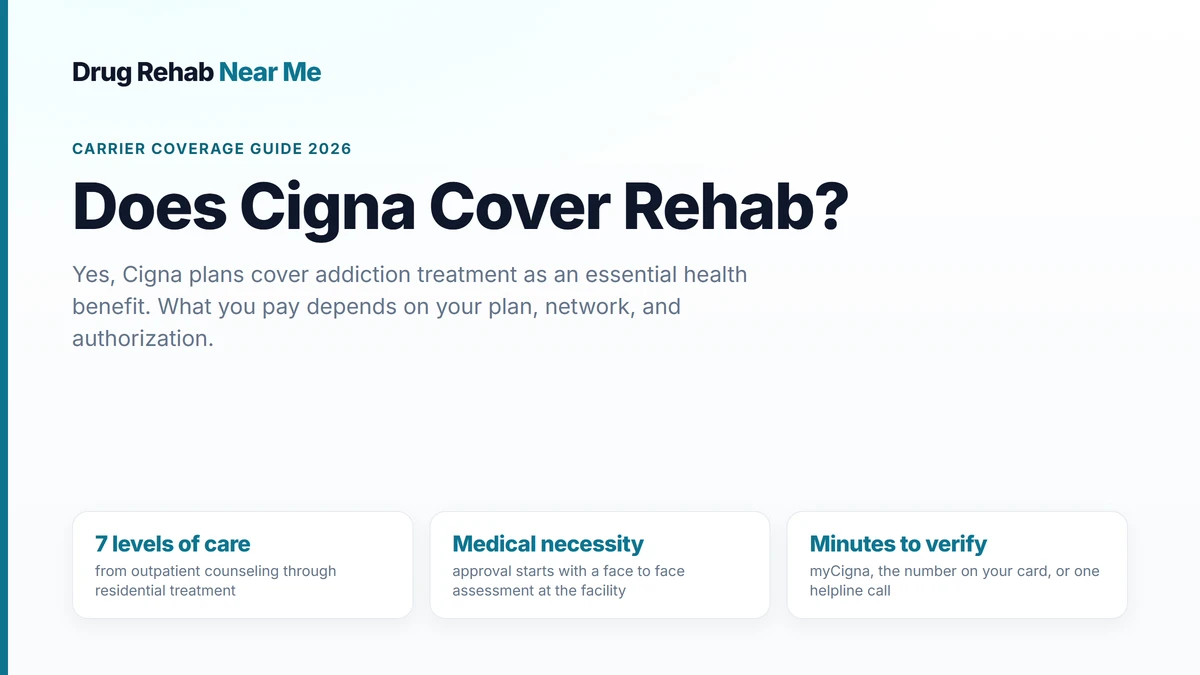
Yes, Cigna health plans cover drug and alcohol rehab. Federal law treats substance use disorder treatment as an essential health benefit, and Cigna's behavioral health benefits cover the full ladder of care, from outpatient counseling through residential treatment. What you actually pay depends on your specific plan, whether the facility is in Cigna's network, and whether the level of care gets authorized, so the real answer for your situation comes from a benefits check, not a search result.
If you have searched this question already, you have probably noticed something unhelpful: Cigna's own pages describe what treatment is without saying what your plan pays, and most of the other pages are written by treatment centers that want you in their program specifically. This guide is neither. We run a directory, and our only aim here is that you leave knowing what Cigna covers, how Cigna decides, and how to verify your benefits in a few minutes without committing to anything.
Does Cigna Cover Rehab at Every Level of Care?
Cigna organizes addiction treatment by level of care, and its published materials describe the same ladder used across US treatment. Every level below is a covered benefit category under Cigna behavioral health plans, for alcohol and drugs alike. Which level your plan approves, and at what cost to you, depends on the plan and on medical necessity.
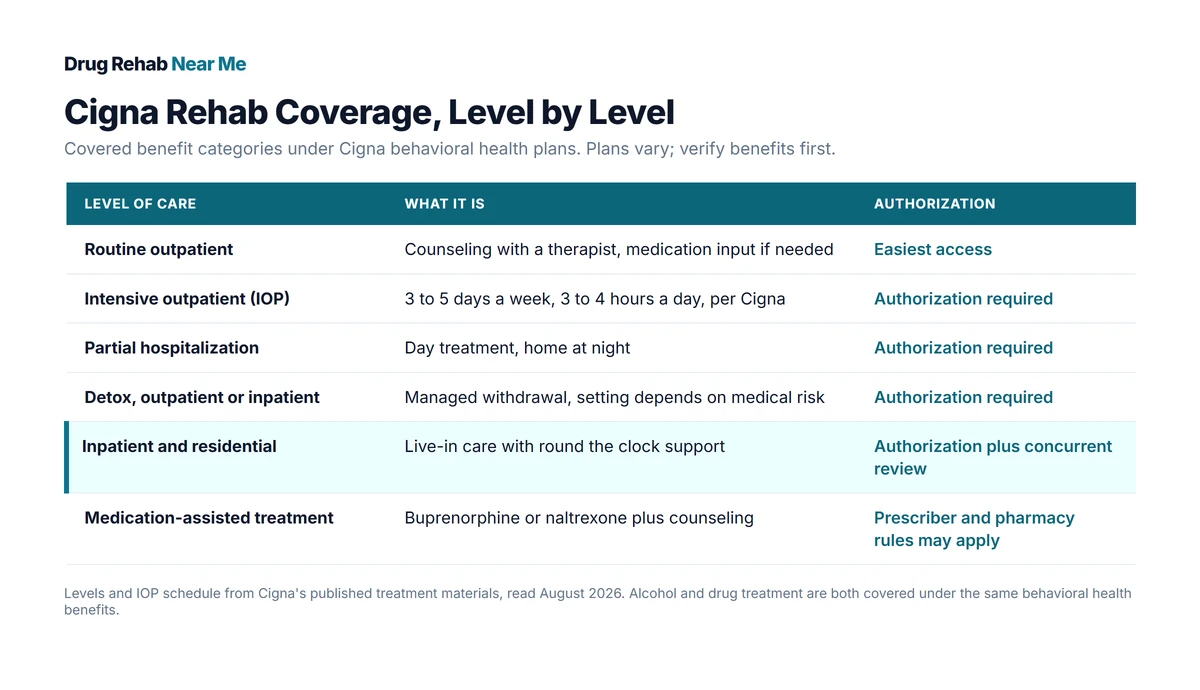
- Routine outpatient care. Individual counseling with a therapist, sometimes with a psychiatrist or addiction specialist involved for medication decisions. The lightest touch and the easiest to access.
- Intensive outpatient programs (IOPs). Structured treatment that Cigna describes as usually three to five days a week, three to four hours a day, built so you can keep working and living at home.
- Partial hospitalization programs (PHPs). Day treatment, more hours than an IOP, still sleeping at home.
- Detox, outpatient or inpatient. Cigna covers ambulatory detox for withdrawal that can be managed safely at home, and inpatient detox when withdrawal needs medical supervision around the clock.
- Inpatient and residential treatment. Live-in care, covered when the plan's medical necessity review supports it.
- Medication-assisted treatment. Medications like buprenorphine or naltrexone plus counseling, covered under the same behavioral and pharmacy benefits, sometimes with rules about which prescribers or pharmacies you use.
- Co-occurring mental health care. Depression, anxiety, and trauma treatment fall under the same behavioral health benefits, which matters because addiction rarely travels alone.
Two things Cigna's own materials make clear. Twelve-step programs like AA and NA are community-based and free, so they are not an insurance question at all. And the levels above are not a menu you pick from; Cigna expects a clinical evaluation to recommend the level of care, which leads to the next section. If you want the levels themselves explained in more depth first, our guide to what rehab is walks through each one.
How Cigna Decides What to Approve
For most structured levels of care, Cigna requires authorization before treatment starts, and its published description of that process is worth knowing word for word. The facility performs a face-to-face assessment, sends the clinical information to your plan with a request for authorization, and the plan then determines the level of care it will authorize based on medical necessity guidelines.
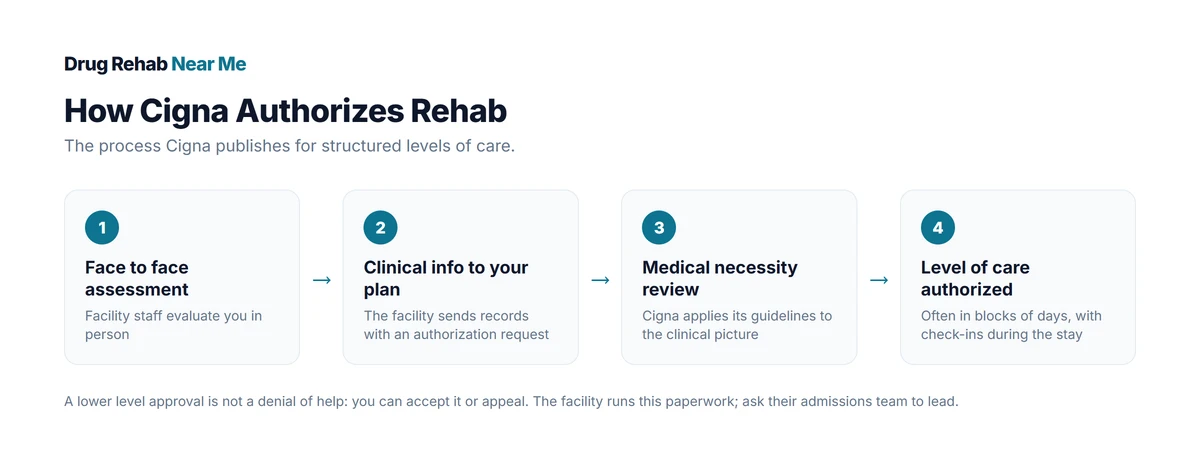
Read that again, because it contains three practical lessons. First, the facility starts the paperwork, not you; admissions teams run these requests every day and know what Cigna wants documented. Second, the decision is about level of care, not a yes or no on help. Cigna may authorize an IOP when a facility requested residential, and that is an approval you can accept or appeal, not a closed door. Third, approvals track the clinical evidence, so a documented history of withdrawal risk, previous treatment attempts, or a co-occurring diagnosis genuinely changes outcomes.
Cigna's materials also describe when a higher level of care should be considered: when someone is sticking to their current treatment but still drinking or using, struggling with medical complications, or functioning worse over time. If a lower level of care is not holding, that language is your appeal in a sentence.
Expect stays to be approved in blocks of days with check-ins along the way, which is standard concurrent review across insurers, not a Cigna quirk. The facility handles those check-ins too.
What Rehab Costs With Cigna
No honest page can print your number, because Cigna sells hundreds of plan designs. What we can give you is the frame. Your cost for covered, in-network care is your deductible plus your share of costs until you hit your plan's out-of-pocket maximum, and federal rules cap that maximum at $10,600 for an individual on 2026 marketplace plans. Many employer plans set lower caps. The mechanics of deductibles, coinsurance, and that cap, with a worked dollar example, live in our guide to insurance coverage for rehab.
Plan tier moves the number more than anything else you chose at enrollment. A Bronze marketplace plan trades a low premium for a high deductible, so treatment early in the year costs more out of pocket; Gold flips that. Employer plans vary too much to generalize, which is the polite way of saying: check yours.
One quiet advantage worth knowing about: some Cigna employer plans include an employee assistance program. An EAP can provide sessions with a licensed counselor at no cost, before your medical benefits even come into play, and it can be a low-stakes first conversation about drinking or drug use. Check your benefits portal or HR materials for whether you have one.
One more cost question worth asking any program directly: what the quoted rate includes. Some facilities bundle detox, medications, therapy, and aftercare planning into a single authorization; others bill them separately, and a stay quoted as one number can arrive as four bills. Asking "what is included, and what gets billed separately" before admission prevents the most common billing surprise in addiction treatment.
For what treatment costs before insurance, from state-funded programs to residential care, our rehab cost guide has the full ranges.
Cigna Plan Types and the In-Network Question
The plan type on your ID card sets the rules of the game. Cigna HMO plans generally cover in-network care only and may route you through a primary doctor first. PPO plans cover out-of-network care at a worse rate and skip the referrals. EPO and Open Access designs sit in between: no referrals, but the network boundary is firm. If you see LocalPlus on your card, your network is a regional one, so checking a specific facility matters even more.
Whatever the plan type, the in-network question is the expensive one. In-network facilities have contracted rates with Cigna, your share is smaller, and your spending counts toward your out-of-pocket cap. Out of network, PPO plans pay less, other plan types may pay nothing, and the bills often do not count toward your in-network cap. A single network mistake can cost more than every other decision combined.
Three ways to check network status: log in to myCigna and use the provider search, call the member services number on your card, or give a facility your member ID and let their admissions team run your benefits, which they will do at no charge. Nationally, insurance acceptance is the norm; 82% of the 17,706 facilities in the 2026 federal treatment directory accept private insurance. The question is never whether facilities take insurance. It is whether the one you want is in your plan's network.
How to Verify Cigna Insurance for Rehab
You have three routes, and none of them commits you to anything.
- myCigna. Log in at myCigna.com or the app, open your benefits summary, and look for behavioral health or substance use disorder coverage. You can see your deductible status and out-of-pocket progress without talking to anyone.
- Call Cigna. Use the member services number on the back of your ID card. Ask whether substance use treatment is covered, which levels of care need prior authorization, what your deductible and coinsurance look like for each, and whether a specific facility is in-network. Get a reference number for the call. The full eight-question script is in our insurance guide.
- Talk it through first. If you would rather sort out your options with a person before calling your insurer, call (888) 470-5244. It is free, confidential, and open around the clock. You can also browse facility listings by state, for example residential programs in Florida or intensive outpatient programs in California; every listing shows the payment types the facility reports to the federal directory.

A worry worth naming: checking your benefits does not report you to anyone. Verification is a routine insurance transaction, and treatment records sit behind the same federal privacy rules as the rest of your medical care. Drug Rehab Near Me is an informational directory and referral service, not a treatment provider or an insurer, and nothing on this page is a promise of coverage; plans vary, and your plan's verified answer is the one that counts.
If Cigna Denies Coverage
A denial is a step in the process, not the end of it. You have the right to an internal appeal, where Cigna reviews the decision with fresh eyes, and to an external review by an independent third party after that. Ask the facility's admissions team to drive the appeal; they have the clinical records that win these, and Cigna's own higher-level-of-care language gives them the framework to argue inside.
If the denial pattern looks like addiction care being held to a stricter standard than medical care, that is a parity question, and your state insurance regulator takes those complaints. While an appeal runs, sliding fee scales and payment plans keep options open; our cost guide covers them with the federal data on which facilities offer each.
And if your coverage is through a different carrier entirely, the same playbook applies with different phone numbers; see our guide to Aetna rehab coverage for that carrier's specifics.
Before any of this: if you or someone you love is in immediate danger, call 911. If you are thinking about suicide or are in emotional crisis, call or text 988. Benefits can wait until everyone is safe.
Frequently Asked Questions
Does Cigna cover alcohol rehab?
Yes. Alcohol use disorder treatment is covered under the same behavioral health benefits as drug treatment, from outpatient counseling and IOPs through inpatient detox and residential care. Alcohol withdrawal can be medically serious, which is exactly the kind of clinical evidence that supports authorization for supervised detox.
Does Cigna cover inpatient rehab?
Yes, when the plan's medical necessity review supports round-the-clock care. Inpatient and residential treatment require prior authorization, which the facility requests after a face-to-face assessment. Approvals typically come in blocks of days with concurrent reviews during the stay.
Does Cigna cover detox?
Yes, at two levels: ambulatory detox for withdrawal that can be managed safely while living at home, and inpatient detox when medical supervision is needed. Both sit behind the same assessment and authorization process as other structured levels of care.
Does Cigna cover medication-assisted treatment?
Yes. Medications like buprenorphine and naltrexone, paired with counseling, are covered under behavioral and pharmacy benefits. Some plans limit which prescribers or pharmacies you can use, so ask about those rules when you verify benefits.
Does Cigna cover rehab in another state?
Usually, because Cigna's networks are national, but the answer rides on your plan type. A PPO or Open Access plan generally covers in-network care anywhere in the country, while an HMO or LocalPlus plan may hold you to a regional network outside of emergencies. Confirm network status for the specific out-of-state facility before anyone travels.
How do I find a rehab that accepts Cigna?
Search the provider directory inside myCigna, call member services and ask for in-network facilities near you, or start from a directory like ours: browse programs by state, for example in Texas, then confirm network status before admission. In-network is the detail that decides most of your cost.
Free & confidential, 24/7
Not sure which program fits? Talk it through with someone who can help.