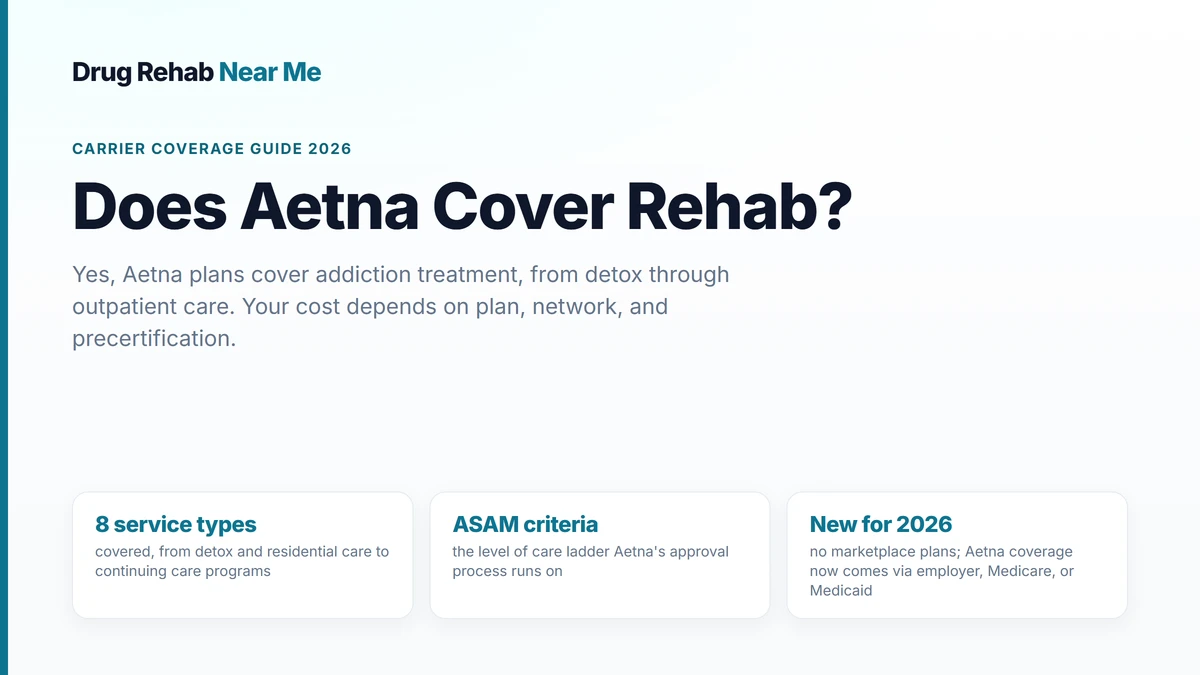
Yes, Aetna health plans cover drug and alcohol rehab. Substance use disorder treatment is an essential health benefit under federal law, and Aetna's behavioral health benefits cover the full range of care, from medically supervised detox through residential treatment, day programs, and outpatient counseling. What you pay depends on your specific plan, whether the facility sits in Aetna's network, and whether the level of care gets precertified, which is why the only answer that matters for you personally comes from a benefits check.
This guide is written from outside the treatment industry. We run a directory, not a facility, so there is no admissions pitch waiting at the bottom. What you will find instead: the one Aetna change worth knowing about this year, what Aetna covers level by level, how its approval process actually works, and the fastest quiet ways to verify your benefits without committing to anything.
One Thing Changed for 2026
Aetna, which is part of CVS Health, stopped selling individual ACA marketplace plans for 2026. The decision was announced in May 2025 and affected roughly a million members who had bought Aetna coverage on the exchanges. Those members were moved to other carriers when their 2025 plans ended. Employer coverage, Aetna Medicare, and Aetna Better Health Medicaid plans were not affected by the exchange decision.
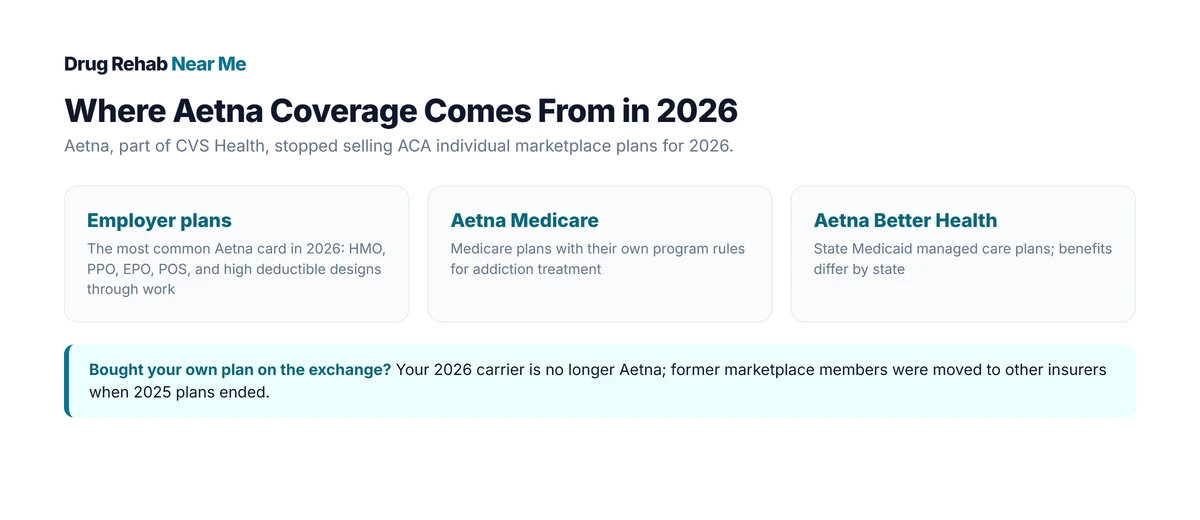
Practically, that means an Aetna card in your wallet in 2026 almost certainly came from one of three places: an employer plan, an Aetna Medicare plan, or a state Aetna Better Health Medicaid plan. If you bought your own coverage on HealthCare.gov for this year, your carrier is no longer Aetna, and the guide you want is our general insurance coverage for rehab explainer, which applies to every carrier. The rest of this page assumes you hold a current Aetna plan.
Aetna Rehab Coverage, Level by Level
Aetna covers addiction treatment for both alcohol and drugs across the standard levels of care. In published Aetna materials and plan documents, the covered service categories look like this:
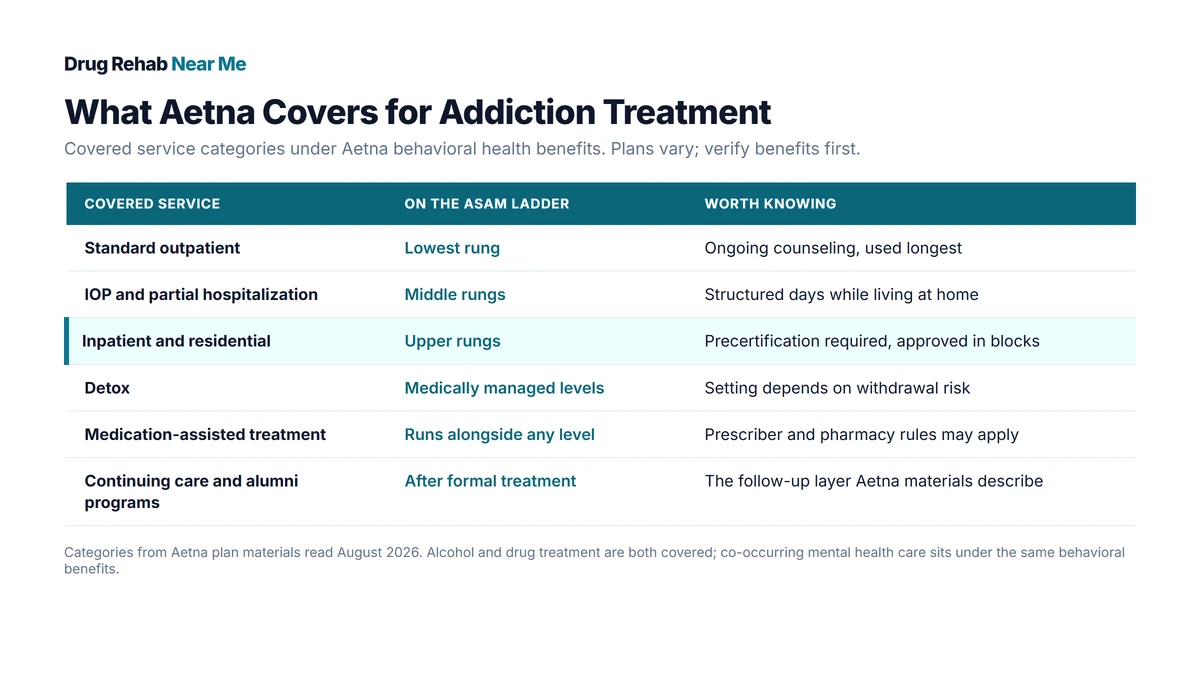
- Detoxification. Medically managed withdrawal, inpatient when the medical risk calls for it. Alcohol, benzodiazepine, and opioid withdrawal are the classic cases where supervised detox gets approved.
- Inpatient and residential rehabilitation. Live-in treatment with structure and clinical staffing, covered when the plan's review supports that level of care.
- Partial hospitalization programs. Full treatment days while sleeping at home.
- Intensive outpatient programs. Several sessions a week around work or school.
- Standard outpatient care. Ongoing counseling, the level most people use longest.
- Medication-assisted treatment. Buprenorphine, naltrexone, or methadone with counseling, under behavioral and pharmacy benefits.
- Co-occurring mental health care. Depression, anxiety, and trauma treatment under the same behavioral health benefits, held to parity with medical care by federal law.
- Continuing care. Aetna materials also describe continuing care and alumni programs, the follow-up layer after formal treatment ends.
A useful piece of translation: Aetna and its reviewers talk about these levels in the language of the ASAM criteria, the American Society of Addiction Medicine's continuum of care. Standard outpatient is one ASAM level, IOPs and PHPs sit at the next levels up, and residential and medically managed inpatient care sit above those. You do not need to memorize the numbering. You just need to know that when Aetna decides what to approve, it is placing you on that ladder, which is exactly what the next section covers. For how long each level typically runs, see our guide to how long rehab lasts.
How Aetna Approves Treatment
For structured levels of care, especially inpatient and residential treatment, Aetna requires precertification: approval before the admission, requested with clinical documentation. The facility's admissions team typically gathers that documentation, submits it, and argues the case; this is routine work for them, and letting them run it is almost always faster than trying to do it yourself.
The decision runs on medical necessity, judged through the same ASAM-style dimensions clinicians use: how risky withdrawal would be, what medical and psychiatric conditions travel with the substance use, what previous treatment has and has not held, and what the home environment looks like. Documented specifics move approvals. A vague request for "rehab" does not; an assessment showing withdrawal risk and two failed outpatient attempts does.
Expect inpatient approvals to come in blocks of days with concurrent reviews during the stay, which is standard across carriers. And one Aetna-specific wrinkle worth asking about: Aetna designates some facilities as Institutes of Quality for particular kinds of care, and where that designation applies it can affect how your plan covers treatment at that facility. When you verify benefits, ask whether it matters for the program you are considering.
If the review lands on a lower level of care than requested, that is an approval you can use, not a rejection. Starting at an IOP and stepping up if it does not hold is a path insurers approve every day, and Aetna's own framework treats still-active symptoms at a lower level as grounds for a higher one.
What Rehab Costs With an Aetna Plan
Nobody can print your number without your plan documents, so here is the honest frame instead. For covered, in-network care you pay your deductible, then your coinsurance share, until you reach your plan's out-of-pocket maximum for the year. Federal rules cap that maximum at $10,600 for an individual in 2026, and many employer plans set lower caps. The full mechanics, including a worked dollar example on a $15,000 stay, live in our insurance guide.
Two Aetna-flavored notes. If your employer plan is a high-deductible design paired with an HSA, you will pay the full negotiated rate until the deductible is met, which makes the timing of treatment within the plan year a real financial variable. And many employer packages that include Aetna medical coverage also include an employee assistance program; EAP counseling sessions typically cost nothing and can be a discreet first step while you sort out the bigger picture. If you do have an HSA alongside a high-deductible plan, remember what the account is for: treatment costs paid from HSA funds are paid with pre-tax dollars, which quietly discounts your deductible share by whatever your tax rate is.
For what treatment costs before any insurance, from state-funded programs to private residential care, our rehab cost guide has the ranges and the no-insurance playbook.
Aetna Plan Types and the Network Question
The plan type on your card sets the network rules. An Aetna HMO covers in-network care only and may require referrals. A PPO covers out-of-network care at a worse rate. An EPO skips referrals but holds the network line. A POS plan blends the two. High-deductible versions of each exist, mostly through employers. If your employer self-funds its plan with Aetna administering it, the rules live in your plan documents rather than any state's insurance code, which occasionally changes your appeal rights, so the phrase "is this plan self-funded?" is worth asking at verification time.
Aetna Medicare plans and Aetna Better Health Medicaid plans cover addiction treatment under their own program rules, which differ by state and plan; if that is your coverage, verify directly with the plan. This page, like the site's other coverage guides, focuses on private insurance. If your household has a different commercial carrier, our Cigna coverage guide follows the same playbook for that carrier.
Whichever plan type you hold, in-network status is the question that moves the money. In-network facilities bill Aetna at contracted rates and your spending counts toward your cap; out of network, your share grows and sometimes stops counting toward the in-network cap entirely. Insurance acceptance itself is rarely the obstacle: 82% of the 17,706 facilities in the 2026 federal treatment directory accept private insurance. The work is matching a specific facility to your specific network. That includes geography: PPO and POS members generally keep national in-network access when traveling for treatment, while HMO members should confirm regional limits before considering an out-of-state program.
How to Verify Your Aetna Benefits
Three quiet routes, none of which commits you to anything:
- The Aetna member site or app. Log in, open your benefits, and look for behavioral health or substance use disorder coverage. Your deductible progress and out-of-pocket status are usually right there.
- The number on your ID card. Ask member services whether substance use treatment is covered, which levels need precertification, what your deductible and coinsurance are for each level, whether a specific facility is in-network, and whether any Institutes of Quality rules apply. Write down the reference number and the representative's name. The full eight-question script is in our insurance guide.
- Talk it through with a person first. Call (888) 470-5244, free and confidential, any hour. Or browse programs directly, for example inpatient programs in Florida, medication-assisted programs in Texas, or everything in New York; every listing shows the payment types the facility reports to the federal directory.

Checking benefits does not notify your employer and does not start a treatment record; it is a routine insurance inquiry, and medical privacy law covers everything that follows. Drug Rehab Near Me is an informational directory and referral service, not a treatment provider or an insurer. Nothing on this page is a guarantee of coverage: plans vary, and the verified answer from your own plan is the only one that counts.
If Aetna Denies Coverage
You have formal rights: an internal appeal reviewed by different eyes, then an external review by an independent third party. Ask the facility's admissions team to lead the appeal with the clinical record; documented withdrawal risk, co-occurring conditions, and failed lower-level attempts are what win these. If addiction care seems to be held to a stricter standard than medical care on your plan, that is a parity concern your state insurance regulator will take, unless the plan is self-funded, in which case the federal Department of Labor handles it.
While an appeal runs, keep moving: sliding fee scales, payment plans, and negotiated self-pay rates are all real options, and the cost guide shows which kinds of facilities offer each, with federal data.
Above all of it: if you or someone you love is in immediate danger, call 911. If you are thinking about suicide or are in emotional crisis, call or text 988. Coverage questions keep; safety does not.
Frequently Asked Questions
Does Aetna cover alcohol rehab?
Yes. Alcohol use disorder treatment is covered under the same behavioral health benefits as drug treatment, including supervised detox, residential care, day programs, outpatient counseling, and medications like naltrexone. Alcohol withdrawal carries real medical risk, which tends to support authorization for monitored detox.
Does Aetna cover inpatient rehab?
Yes, when precertification confirms medical necessity for round-the-clock care. The facility requests approval with clinical documentation, and stays are typically approved in blocks with reviews along the way. An approval for a lower level of care instead is usable and appealable, not a dead end.
Does Aetna cover detox?
Yes. Detoxification is one of Aetna's covered service categories, in outpatient or inpatient settings depending on medical risk. It usually requires precertification, which the treating facility handles.
Does Aetna cover medication-assisted treatment?
Yes. Medications such as buprenorphine, naltrexone, and methadone, combined with counseling, are covered through behavioral and pharmacy benefits. Some plans apply prescriber, pharmacy, or prior authorization rules to specific medications, so ask when you verify.
Does Aetna cover mental health treatment alongside addiction care?
Yes. Co-occurring depression, anxiety, and trauma care fall under the same behavioral health benefits, and federal parity law requires coverage no more restrictive than medical care. Integrated dual-diagnosis programs are covered the same way other levels of care are: through the medical necessity process.
How do I find a rehab that accepts Aetna?
Use the provider search in your Aetna member account, ask member services for in-network facilities near you, or start from a directory: browse programs by state, shortlist the ones whose listed payment types fit, then confirm network status with Aetna before admission. That last confirmation is the step that protects your wallet.
Free & confidential, 24/7
Not sure which program fits? Talk it through with someone who can help.