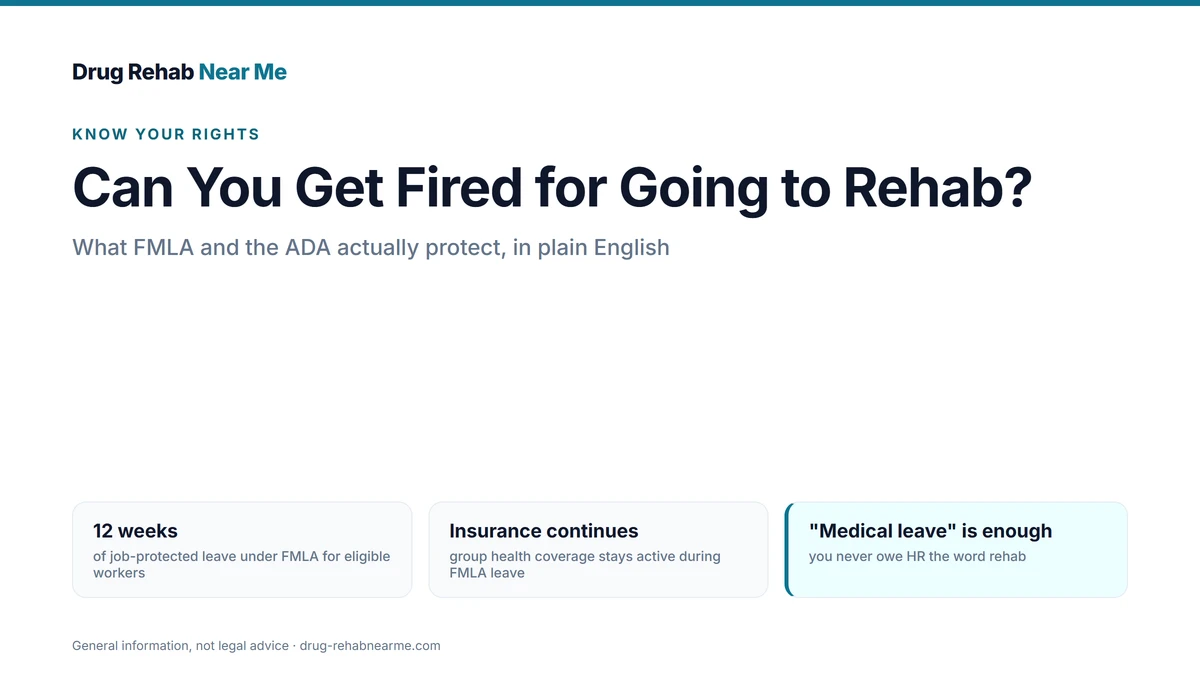
In most cases, no: firing you simply because you sought addiction treatment is illegal when federal protections apply. The Family and Medical Leave Act gives eligible workers up to 12 weeks of unpaid, job-protected leave for treatment, and the Americans with Disabilities Act protects people in recovery from discrimination. But those protections have edges, and the people who get burned are usually the ones who never learned where the edges are.
So this guide gives you the honest version: exactly what the law protects, exactly what it does not, and the word-for-word way to request leave from HR without ever saying "rehab" out loud.
Quick disclosure before the details: this is general information, not legal advice. Employment law has federal, state, and industry layers, and your situation has facts we cannot see. For anything contested, talk to your HR department or an employment attorney.
The Honest Answer Has Three Layers
Whether your job survives rehab mostly comes down to timing and paperwork, and it helps to see the three zones clearly:
- Protected: seeking treatment proactively. You ask for medical leave, you follow the FMLA process, you enter treatment. This is the scenario the law was built for.
- Gray zone: what happened before you asked. If there was an incident (a failed drug test, showing up impaired) before you requested leave, the leave request does not erase it. Discipline for past conduct can proceed.
- Not protected: continuing to use on the job. No law protects being impaired at work, using at work, or violating a clearly communicated substance policy. The protections cover getting well, not staying sick.
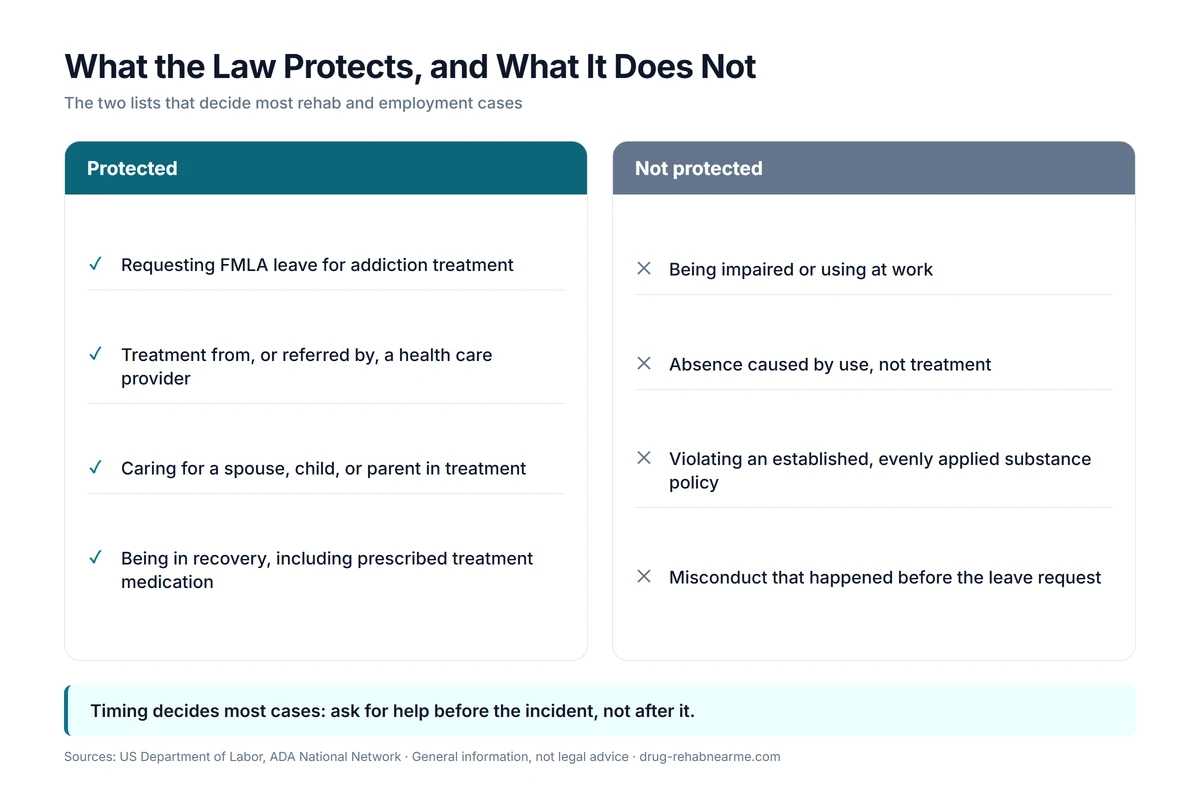
The practical takeaway is blunt: ask for help before the incident, not after. The employee who walks into HR and requests treatment leave is in a completely different legal position than the one who mentions rehab for the first time at a termination meeting.
FMLA: The 12 Week Job Shield
The Family and Medical Leave Act is the main protection, and for addiction treatment it works like this. Substance use disorder treatment can qualify as a serious health condition, which entitles an eligible employee to up to 12 weeks of unpaid leave in a 12 month period. During the leave your group health insurance continues, and when you come back, you are entitled to your same job or one nearly identical to it. Your employer cannot fire, demote, or punish you for using the leave.
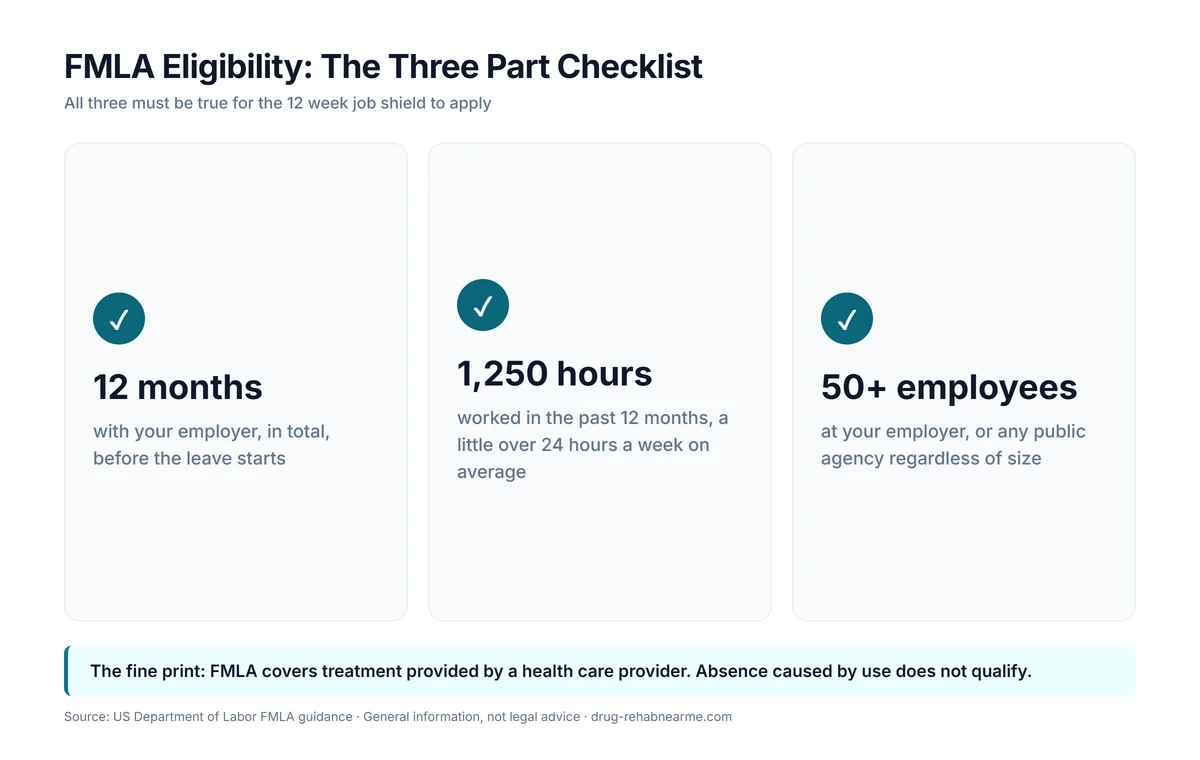
Eligibility is a three-part checklist, and all three must be true:
- You have worked for your employer for at least 12 months
- You worked at least 1,250 hours in the past 12 months (a little over 24 hours a week on average)
- Your employer is a public agency or has 50 or more employees
Now the fine print, straight from the Department of Labor's own FMLA guidance, because this is the part every treatment center blog skips:
- FMLA covers treatment, not use. The leave must be for treatment provided by a health care provider, or by a treatment program on a provider's referral. Missing work because of the substance itself (the hangover, the bender, the arrest) does not qualify for FMLA protection.
- An existing substance policy still applies. If your employer has an established policy, communicated to all employees and applied evenly, that says employees can be terminated for substance abuse under certain circumstances, you can be terminated under that policy even while you are on FMLA leave. The leave protects you from being fired for taking leave; it is not an amnesty for policy violations.
One more FMLA fact that almost nobody knows: the same leave is available to care for a spouse, child, or parent who is receiving substance abuse treatment. If you are the family member reading this on someone else's behalf, your own job has protection too while you help them through it. Our guide on helping someone who does not want help covers that side of the road.
The ADA: Protection for People in Recovery
The Americans with Disabilities Act picks up where FMLA leaves off, and it draws one bright line. People in recovery from addiction who are no longer using illegal drugs can be protected as having a disability. People currently using illegal drugs are specifically excluded when the employer acts because of that use. The law protects the recovery, never the active use.
For alcohol the rule is softer but similar. Alcohol use disorder can qualify as a disability, and an employer cannot punish you just for having it or for getting treatment for it. But performance and conduct standards still apply with full force: an employer can discipline or fire someone whose drinking hurts their job performance, and can ban alcohol at work entirely.
The ADA also gives you two practical tools:
- Reasonable accommodations. If you qualify, you can request schedule changes, like leaving early two evenings a week for an outpatient program. You will need to disclose the condition to HR and may need medical documentation, but the request itself is a protected right.
- Hiring protections. Employers cannot ask job applicants whether they have ever been treated for addiction, and you never have to explain that a gap in your resume was treatment. Questions about current illegal drug use are allowed; questions about past addiction or treatment history are not.
Worth knowing in 2026: medications used to treat opioid addiction, like methadone, buprenorphine, and naltrexone, are lawful prescribed medicine. Taking them as prescribed is treatment, not "current use", and firing someone over properly prescribed treatment medication raises exactly the kind of discrimination the ADA exists to address.
Who Actually Finds Out at Work
The fear underneath the legal question is usually social: will everyone know? Mostly, no, and the walls are thicker than people expect.
Addiction treatment records have their own federal confidentiality rule, 42 CFR Part 2, which forbids treatment programs from sharing your records without your written consent, protection that goes beyond ordinary HIPAA privacy. Your FMLA paperwork goes through HR as a medical leave; the medical certification comes from your provider, and your manager is not entitled to your diagnosis. Coworkers learn what you choose to tell them. "I'm out on medical leave for a few weeks" is a complete sentence, and thousands of people use exactly that one.
If your company has an Employee Assistance Program, it is confidential by design: EAP counselors can arrange treatment referrals without your manager ever being in the loop. For a lot of working people, the EAP phone number is the least scary first step in the building.
How to Tell Your Employer You Are Going to Rehab
Here is the sequence that protects you at every step:
- Go to HR, not your manager. HR handles medical leave under confidentiality rules; your manager has no need to know the diagnosis. If there is no HR, go to whoever administers benefits.
- Say "medical leave", not "rehab". You are never required to use the word. A medical condition requiring treatment is all the law needs.
- Use a script like this: "I have a medical condition, and my doctor has recommended a course of treatment that requires a leave of absence. I'd like to request FMLA paperwork and understand my options. I want to handle this the right way and make the transition smooth for the team."
- Ask three questions while you are there: whether you are FMLA eligible, whether the company offers short-term disability that could pay part of your salary during leave, and whether there is an EAP.
- Route the certification form to your treatment provider. They complete these constantly and know exactly what to write.
- Keep everything in writing. Follow up conversations with a short email summary. If anything ever goes sideways, the paper trail is your best friend.

What you do not have to disclose: the substance, the diagnosis, the name of the facility, or your history. What you do have to do: follow your employer's normal notice procedures for leave (usually 30 days notice when the leave is foreseeable, or as soon as practical when it is not) and return the certification paperwork on time.
When You Can Still Be Fired: No False Comfort
An honest guide has to draw the map's dangerous zones too:
- Small employers. Under 50 employees, FMLA does not apply. Some states have their own family and medical leave laws with lower thresholds, so check yours, but in a small at-will shop, protection may be thin.
- New employees. Less than 12 months in, or under 1,250 hours, means no FMLA eligibility. The ADA may still apply, and honesty with HR sometimes buys goodwill the law does not require.
- The failed test that came first. A positive drug test under an established, evenly applied policy can support termination even if you request leave afterward. The leave request is not retroactive armor.
- Safety-sensitive and regulated jobs. Commercial drivers, pilots, and other federally regulated roles have their own testing and return-to-duty rules that sit on top of everything here.
- Misconduct is still misconduct. Theft, violence, or serious policy violations connected to substance use are not laundered by a treatment admission.
If any of these describe your situation, do not guess. Read your employee handbook, and spend an hour with an employment attorney before you make a move. Many offer free consultations, and one hour of advice beats months of regret.
Rehab Without Leaving Work at All
Twelve weeks away is not the only shape treatment comes in. Intensive outpatient programs commonly run on evening schedules built for working people, and standard outpatient care can mean a few sessions a week around your job. Plenty of people get well without their employer ever knowing anything happened. Our inpatient vs outpatient guide explains how to tell which level of care fits, and our guide to how long rehab takes puts real numbers on the time commitment. You can also browse intensive outpatient programs in California or search your own state to see evening-friendly options near you.
The Job Fear, Priced Out
Here is the picture worth stepping back for. The Substance Abuse and Mental Health Services Administration has estimated that 10.8 million full-time workers in the United States have a substance use disorder. The overwhelming majority keep showing up sick, year after year, in large part because of the exact fear this article is about. Meanwhile the condition itself is what actually threatens the job: the missed Mondays, the slipping performance, the near-misses. Treatment is not the career risk. Untreated addiction is.
The other two objections usually standing next to the job fear are money and logistics, and both have answers: our rehab cost guide shows what treatment really costs (usually far less than the sticker price once insurance applies), and our insurance guide shows how to verify coverage in one call. You can browse programs by state, like Texas, or call (888) 470-5244 to talk through options that fit around a work schedule. The line is free, confidential, and open 24/7. Drug Rehab Near Me is an informational directory and referral service, not a treatment provider or a law firm, and calling commits you to nothing. And if you are in crisis right now rather than planning, call or text 988; the job questions can wait until you are safe.
Frequently Asked Questions
Can you get fired for going to rehab?
Not legally, in most cases, if you are FMLA-eligible and request leave before any policy violation occurs. The exceptions are real: employers under 50 employees, employees under 12 months of tenure, conduct that predates the leave request, and established substance policies applied evenly to everyone.
Does FMLA cover alcohol rehab?
Yes. Treatment for alcohol use disorder qualifies for FMLA leave the same way drug treatment does, as long as the treatment is provided by a health care provider or a program on a provider's referral and you meet the standard eligibility rules. Absences caused by drinking itself, rather than treatment, are not protected.
Do I have to tell my boss why I am taking leave?
No. Your manager is not entitled to your diagnosis. FMLA paperwork runs through HR, the medical certification comes from your provider, and "medical leave" is all anyone else needs to hear. Treatment records themselves are protected by 42 CFR Part 2, a federal confidentiality rule specific to addiction treatment.
What if my company has fewer than 50 employees?
FMLA will not apply, but you are not out of options. Check whether your state has its own medical leave law with a lower threshold, ask about short-term disability, consider an evening outpatient program that needs no leave at all, and consider talking to HR anyway; small employers often work with employees who come forward before there is a problem.
Can future employers find out I went to rehab?
Not through legal channels. Treatment records cannot be released without your written consent under 42 CFR Part 2, rehab does not appear on background checks, and the ADA bars interviewers from asking whether you were ever treated for addiction. A resume gap needs no explanation beyond "I was dealing with a medical issue, which is fully resolved."
Does an employer have to offer rehab before firing someone?
Generally no. Federal law does not require employers to offer treatment or a "firm choice" between rehab and termination before acting on genuine policy violations or performance problems. Some employers, union contracts, and public agencies do offer that option voluntarily, which is one more reason to raise your hand before an incident forces the issue.
Free & confidential, 24/7
Not sure which program fits? Talk it through with someone who can help.