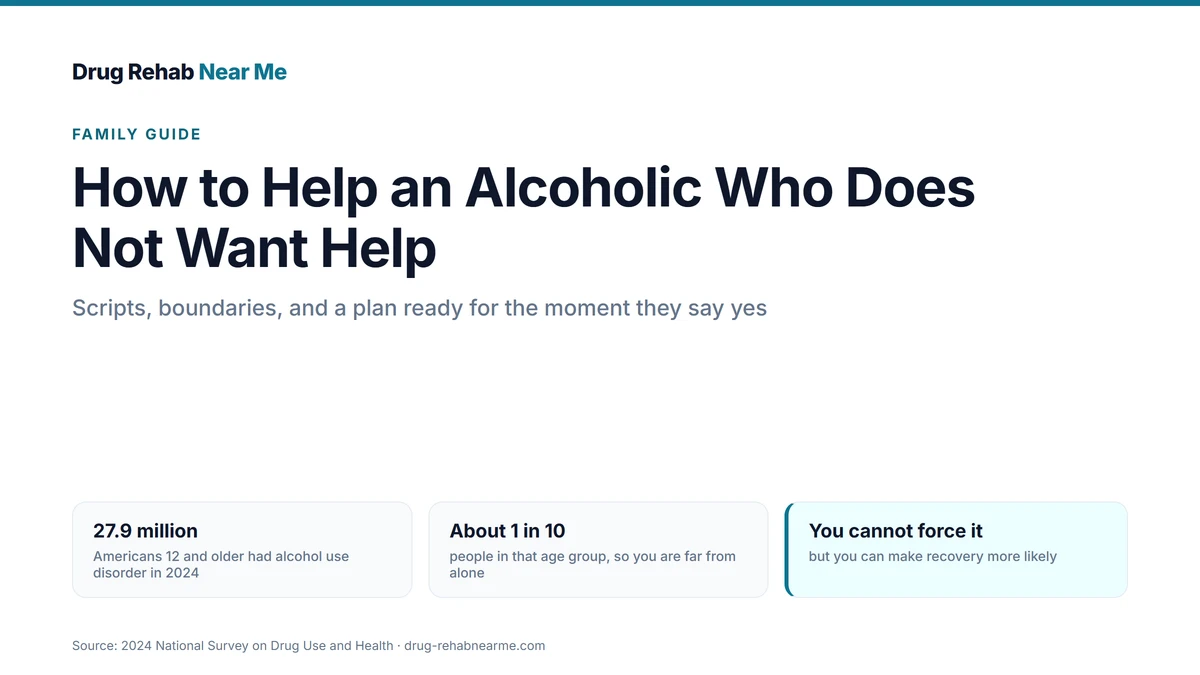
You cannot force someone to stop drinking. What you can do is make recovery more likely: talk with them in sober moments using specific, blame-free language, stop shielding them from the consequences of their drinking, set boundaries you will actually keep, and have a concrete plan ready for the moment they say yes. That combination moves more people into treatment than pleading, threats, or waiting for a rock bottom that may never come.
If you love someone who drinks too much, you are not a rare case. The 2024 National Survey on Drug Use and Health counted 27.9 million Americans ages 12 and older with alcohol use disorder in the past year, about 1 in 10 people. Behind most of them is a spouse, a parent, or a friend lying awake at night trying to figure out what to do.
This guide is for that person. It covers what to say (with actual scripts), where helping ends and enabling begins, how to set boundaries that hold, and what your options are when the answer keeps being no.
Why They Refuse Help
Denial is not simple stubbornness. It is part of the condition. Admitting the drinking is out of control means facing shame, imagining a life without the one thing that reliably shuts off stress, and accepting a label nobody wants. So the mind does impressive gymnastics instead: everyone drinks after work, last weekend was a one-off, you are the one blowing this out of proportion.
Understanding that changes your job description. You are not going to out-argue an addiction. Al-Anon, the support program for families, teaches three C's that are worth taping to your mirror: you didn't cause it, you can't control it, and you can't cure it.
What you can do is change the conditions around the drinking. People with alcohol problems rarely decide to get help because someone finally found the perfect words. They decide when staying the same becomes harder than changing, and the people closest to them have real influence over which one is harder. Everything below is about using that influence well.
How to Talk to an Alcoholic About Getting Help
The conversation matters less than the conditions around it. Get these five right before you say a word:
- They are sober. Talking to someone who has been drinking is talking to the alcohol. Wait for a clear-headed moment, often morning.
- You are calm. If you open the conversation furious, it becomes a fight about your anger instead of their drinking.
- You are alone together. An audience triggers defensiveness. This is a conversation, not a hearing.
- You have specifics. Not "you always drink too much" but "you fell asleep at the table at Maya's birthday on Saturday".
- You expect a no. This is the first conversation, not a verdict. Its goal is to be heard, not to win.
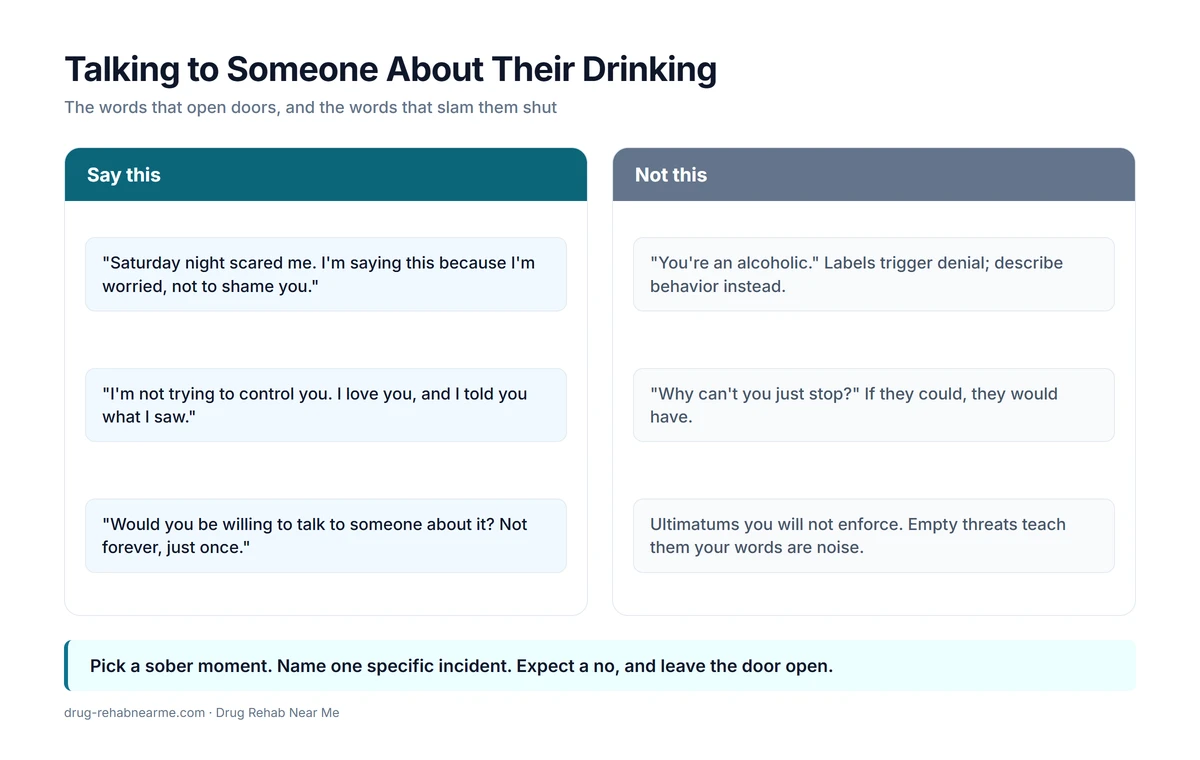
Then say something like this, in your own voice:
"I want to talk about something because I love you, and I need you to just hear me out for two minutes. Saturday night scared me. You had eight or nine drinks, you got in the car anyway, and I was up until 2 a.m. not knowing if you were okay. I'm not saying this to shame you. I'm saying it because I'm worried, and I think the drinking has gotten bigger than both of us. Would you be willing to talk to someone about it? Not forever, just once."
Notice what that script does. It asks permission, names one specific incident, uses "I" statements about your own fear, avoids the word alcoholic entirely, and ends with the smallest possible ask: one conversation with a professional, not a 30 day program.
If there was an incident last night, the morning after is often the most honest window you will get. Keep it short:
"I'm not here to replay last night. You already know what happened. I just want you to know that when you're ready to do something about it, I will help you every step of the way. I mean that."
And when they get defensive, and they probably will, do not chase them into the argument. De-escalate and leave the door open:
"I'm not calling you anything, and I'm not trying to control you. I love you and I told you what I saw. That's all. We don't have to solve it tonight."
Just as important is what not to say. These backfire almost every time:
- "You're an alcoholic." Labels trigger denial. Describe behavior instead.
- Ultimatums you will not enforce. Every empty threat teaches them your words are noise.
- Anything said while they are drunk. Save it. They will not remember, and it may turn dangerous.
- "Why can't you just stop?" If they could, they would have.
- Piling on shame. Shame is fuel for drinking, not a cure for it.
Helping or Enabling: Where the Line Is
Enabling is anything that stands between the drinker and the natural consequences of drinking. That is the whole definition, and it is uncomfortable, because by that standard most loving families enable constantly. It comes from a good place. It also quietly removes every reason to change.
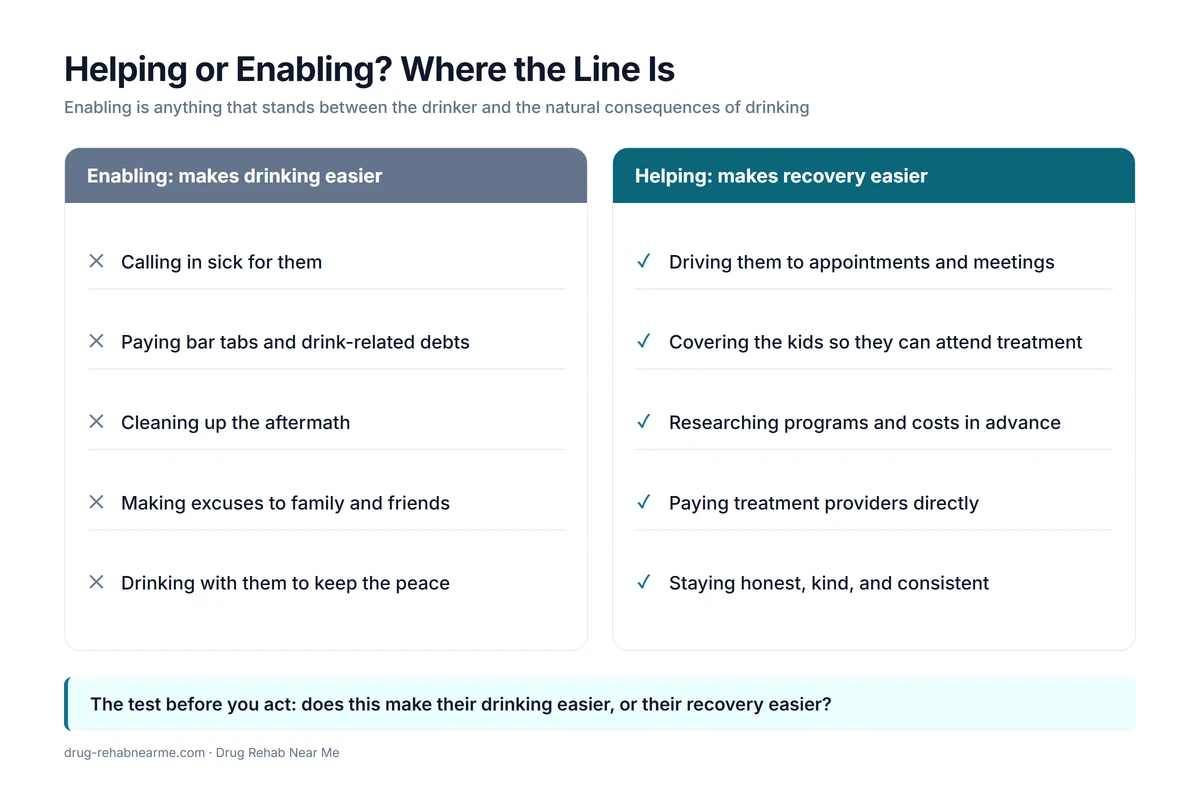
Enabling usually looks like this:
- Calling their boss to say they have a stomach bug when they are hungover
- Paying the credit card bill that is mostly bar tabs, or covering the DUI lawyer with no conditions attached
- Cleaning up messes, physical or social, so the weekend "never happened"
- Making excuses to family and friends ("he's just stressed at work")
- Drinking with them to keep the peace, or buying the alcohol yourself
Real help puts energy toward recovery instead of toward comfort inside the addiction:
- Driving them to a doctor's appointment, an AA meeting, or an assessment
- Watching the kids or covering responsibilities so they can attend treatment
- Researching programs and costs so the path is ready when they are (our guide to rehab costs is a place to start)
- Paying for treatment directly to the provider, if you choose to help financially
- Being honest with them about what you see, kindly and consistently
A useful test before you act: does this make their drinking easier or their recovery easier? If the honest answer is the first one, it is enabling, no matter how much love is in it.
Boundaries That Actually Hold
A boundary is not a punishment and it is not an attempt to control them. It is a statement about what you will do, because your behavior is the only thing you actually control. Compare these:
- "You can't drink anymore" is a demand. You cannot enforce it.
- "I won't get in a car with you when you've been drinking" is a boundary. You can enforce it every single time.
Boundaries that families of heavy drinkers commonly set:
- "I won't lie for you again. If you miss work, you make the call yourself."
- "I'm not giving you cash anymore. I will pay for groceries, a counselor, or treatment, and nothing else."
- "If you drink around the kids, they and I will sleep at my sister's that night."
- "I love you, but I won't sit at the table while you're drunk. I'll be in the other room."
Two rules make boundaries work. First, only set ones you are truly willing to keep, because a boundary you drop under pressure is worse than no boundary at all. Second, state them once, calmly, when they are sober, and then let your actions do the repeating. You will probably be tested. That is not the boundary failing; that is the boundary working.
If They Still Say No
Sometimes you do everything right and the answer is still no. Hear this clearly: no today is not no forever. Most people who eventually get help refused it more than once first. Your job shifts from persuading to waiting well, and waiting well has a real playbook.
Keep one sentence alive between you: "When you're ready, I'll help you, and nothing you've done changes that." Then stop selling. Nagging hardens a no; a standing offer quietly outlasts it.

Look into CRAFT, which stands for Community Reinforcement and Family Training. It is an approach built specifically for families of people who refuse treatment. Instead of confrontation, it trains you to make sober time more rewarding (be present, warm, engaged when they are not drinking), to step back and go do your own thing when they are drinking, and to let natural consequences arrive on schedule. Many therapists offer CRAFT-based family work, and it tends to be far less brutal on the family than an ultimatum war.
Get support for yourself, separately from whether they ever get help. Al-Anon exists for exactly your situation, it is free, and there are meetings in nearly every town and online. And if a treatment facility feels like too big a leap for your person, a peer group might not: research published in the International Journal of Drug Policy in 2026 found mutual-help groups like AA to be similar in effectiveness to formal treatment for many people with alcohol problems. A single meeting is a much smaller yes than a rehab admission.
One more thing families rarely realize: helplines are for you too. You can call (888) 470-5244 and talk through your situation with a real person, for free, even if the one drinking never touches a phone. Sometimes the family member makes the first call, and the plan starts there.
When a Formal Intervention Makes Sense
The television version of an intervention, where the family ambushes the drinker in a living room full of letters, is riskier than TV makes it look. Done badly, it humiliates the person, confirms their belief that everyone is against them, and pushes the drinking underground.
A planned intervention guided by a trained professional is a different tool, and it has a real place when three things are true: the situation involves serious risk (DUIs, job loss, health scares), direct one-on-one conversations have repeatedly failed, and every participant is prepared to follow through on stated consequences. The professional's job is to keep it structured and to have a treatment placement ready to go that same day, because the window after a yes is measured in hours.
When the danger is severe and every voluntary route has failed, some states let families petition a court for mandatory assessment or treatment. Florida's Marchman Act is the most used example, and we wrote a full plain-language guide to how the Marchman Act works. Other states have their own versions with different rules, like Casey's Law in Kentucky and Ohio, and some states have no such process at all. These are serious legal steps with real requirements, so talk to the clerk of court in your county or an attorney about what applies where you live.
If You Are Scared Right Now
Some situations should skip everything above. If they are unresponsive, breathing strangely, or you cannot wake them after heavy drinking, call 911 now; alcohol poisoning kills people whose friends assumed they were sleeping it off. If they are threatening to hurt themselves or someone else, call or text 988, the Suicide and Crisis Lifeline, or call 911 if the danger is immediate. If you or your children are unsafe because of their drinking, your safety comes first, full stop. Scripts and boundaries are for later.
Be Ready for the Moment They Say Yes
Willingness arrives in narrow windows: the morning after a bad night, the day after a DUI, a health scare in a doctor's office. Families who use those windows are the ones who did their homework in advance. Ready means:
- A shortlist of two or three programs that fit their situation. You can browse what actually operates near you by state and city, for example residential programs in Florida or outpatient programs in California.
- The insurance question answered. Most plans cover addiction treatment, and verifying benefits takes one phone call. Our insurance guide walks through it.
- The job objection handled. "I'll get fired" is one of the most common reasons people refuse. Usually it is wrong; federal law protects many workers who seek treatment. Our guide to rehab and job protection explains FMLA and the ADA in plain English.
- A realistic picture of the commitment. Knowing how long rehab takes turns a scary unknown into a plan.
If you would rather talk it through than research it, call (888) 470-5244. The line is free, confidential, and open 24/7, and you can call before your person has agreed to anything. Drug Rehab Near Me is an informational directory and referral service, not a treatment provider; nobody will pressure you or them, and calling commits you to nothing. What you will get is a clearer picture of the options near you, so that when the yes comes, you are ready that same day.
Frequently Asked Questions
How do you help an alcoholic who does not want help?
You stop trying to force a yes and start changing conditions: talk in sober moments with specific, blame-free language, stop covering for the drinking, set boundaries you will keep, and keep a standing offer of help open. Approaches like CRAFT were designed for exactly this situation, and support like Al-Anon helps you stay steady while you wait for the window.
What should you not say to an alcoholic?
Avoid labels ("you're an alcoholic"), ultimatums you will not enforce, shame, and "why can't you just stop". Never start the conversation while they are drunk. Describe specific incidents and your own feelings instead; behavior can be discussed, a label will be fought.
What is the difference between helping and enabling?
Helping makes recovery easier; enabling makes drinking easier. Paying for a counselor is help. Paying the bar tab, calling in sick for them, or cleaning up the aftermath is enabling, because it removes the consequences that would otherwise push them toward change.
Can you force someone to go to rehab?
For adults, generally no. A handful of states allow court-ordered assessment or treatment in severe cases, such as Florida under the Marchman Act and Kentucky and Ohio under Casey's Law. The rules, evidence requirements, and outcomes vary a lot by state, so read our Marchman Act guide and talk to your county clerk of court or an attorney.
When is it time to stop trying?
You can stop rescuing without stopping loving. If your safety, your children, your health, or your finances are being consumed, it is legitimate to step back, and for some families that means separation or distance. Many people keep one line open ("when you're ready, I'll help") while refusing to live inside the addiction. Al-Anon is full of people walking exactly that line, and a therapist can help you find yours.
How do you help an alcoholic after rehab?
Treat the first months home as the highest-risk stretch, not the finish line. Keep alcohol out of the house, expect mood swings, support their meetings and appointments, and agree in advance on what happens if they drink again. Relapse is common in recovery from alcohol use disorder; it means the plan needs adjusting, not that treatment failed or that your support was wasted.
Free & confidential, 24/7
Not sure which program fits? Talk it through with someone who can help.