Cocaine addiction is treated with behavioral therapies, not a prescription. There is no FDA approved medication for cocaine use disorder, so effective cocaine addiction treatment is built on approaches with proven results: contingency management, cognitive behavioral therapy, and structured programs delivered in both outpatient and residential settings. That is the National Institute on Drug Abuse's own summary of the evidence, and it is the fact every other question on this page hangs on.
You would not know it from searching, though. The results for this topic include a government helpline page, an academic journal review, a British health service page, and at least one rehab blog listing "medicines commonly used" for cocaine addiction, which makes the medication situation sound very different than it is. This guide gives you the straight version: what actually works, what treatment looks like from the first phone call to aftercare, and how to find a program.
Before we start, one disclosure: this site is a directory, not a treatment provider. If talking beats reading right now, you can call (888) 470-5244 any time, free and confidential.
When Cocaine Use Becomes Addiction
Plenty of people convince themselves that a cocaine habit is still recreational long after it stopped being one. The clinical term is cocaine use disorder, and a professional has to diagnose it, but the pattern tends to be visible before anyone says the words out loud.
NIDA describes how tolerance builds with regular use: the same amount stops producing the same effect, so doses get bigger, use gets more frequent, or both. From there, the signals stack up:
- Binges that last longer than planned, followed by a crash of exhaustion and low mood.
- Spending money on cocaine that was supposed to go somewhere else.
- Continuing to use after it has clearly cost you at work, at home, or in a relationship.
- Hiding use, or only feeling social and confident when you have it.
- Trying to cut back and not managing to.
The crash is part of what keeps the cycle spinning. After a binge, the brain's reward system is depleted, and the fastest way to feel functional again appears to be more cocaine. That loop is why a habit that once lived on weekends starts leaking into weekdays, and why plenty of people who still perform at work are further along than anyone around them realizes.
If several of those signs describe you or someone you love, that is enough of a pattern to act on. This is not a rare problem people quietly manage alone: cocaine accounted for about 5% of all US addiction treatment admissions in 2020, which means programs see it every single week.
Is There a Medication for Cocaine Addiction?
No. There is currently no medication approved by the FDA to treat cocaine use disorder. That comes straight from NIDA, and it has not changed despite decades of trials.
You may run into articles listing medicines "used to support" cocaine treatment. Here is the honest translation. Researchers have studied drugs like disulfiram, topiramate, and modafinil for cocaine addiction, and the results have not been strong or consistent enough to earn approval or become routine practice. Approval matters because it means a drug proved itself in large controlled trials; for cocaine, nothing has cleared that bar. A doctor might still prescribe something off label in a specific case, but if a program implies a pill is the core of their cocaine treatment, that is a red flag, not a selling point.
What medication legitimately does in recovery is treat the conditions that travel with cocaine addiction: depression, anxiety, sleep problems, and other mental health conditions. Getting those treated properly makes it much easier to stay engaged with the behavioral work that does the heavy lifting.
Cocaine Addiction Treatment That Actually Works
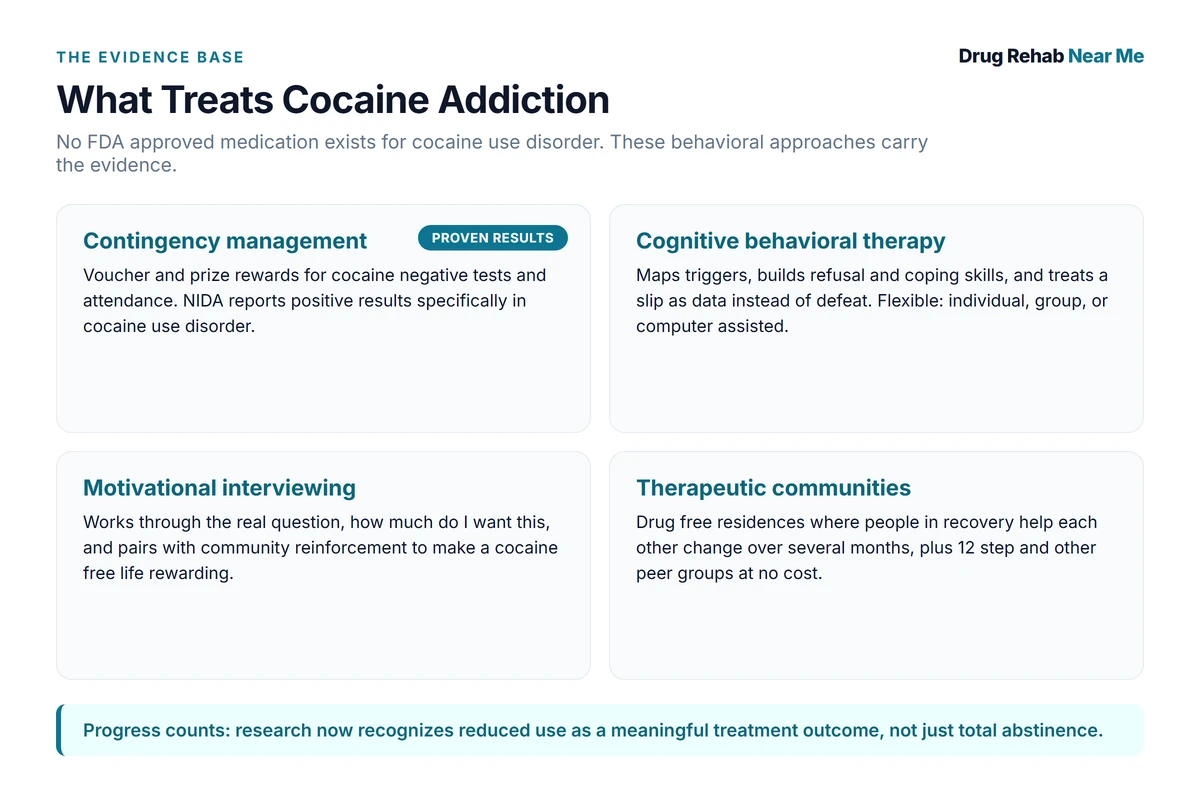
Contingency management
Contingency management, sometimes called motivational incentives, gives people tangible rewards, like vouchers or prizes, for cocaine negative drug tests and consistent attendance. NIDA highlights it as a behavioral therapy with positive results specifically in cocaine use disorder. The logic fits the problem: cocaine trains the brain to chase a fast reward, and contingency management gives the brain a fast reward for the opposite choice. Not every program offers it, so ask directly when you call.
Cognitive behavioral therapy
Cognitive behavioral therapy teaches the skills that keep recovery standing when motivation dips: identifying the people, places, and moods that trigger use, planning responses before the moment arrives, and treating a slip as data instead of defeat. It has been delivered one on one, in groups, and even through studied computer-assisted programs, which makes it one of the most flexible tools in cocaine addiction treatment. A typical course runs weekly sessions over a few months with practice in between, because the skills only stick if they get rehearsed where the triggers actually live.
Motivational interviewing and community reinforcement
Motivational interviewing works through the honest question underneath everything: how much do I actually want to change? Instead of lecturing, a therapist helps you argue your own case. Community reinforcement builds on it by making a cocaine free life genuinely rewarding: repairing relationships, job skills, recreation that competes with the drug instead of just prohibiting it.
Therapeutic communities and peer support
For people who need more than weekly appointments, NIDA points to therapeutic communities: drug free residences where people in recovery help each other change, usually over several months. On the lighter end, 12 step and other peer groups give recovery a social home at zero cost. Aftercare, the support that continues once formal treatment ends, is not an afterthought; it is where long term recovery actually gets built.
One more piece of honesty about outcomes. In 2024, NIH backed research made the case that reduced use is a meaningful treatment outcome for stimulant addiction, not just perfect abstinence. Progress that shows up as fewer binges and better health is still progress. Relapse numbers for stimulant addiction look discouraging out of context; in context they look like every other chronic condition, and the response is the same: adjust the plan, do not abandon the person. And if methamphetamine is part of the picture too, our meth addiction treatment guide covers it; the playbook is similar because no approved medication exists for any stimulant addiction.
What to Expect: Levels of Care and Timeline
Treatment starts with an assessment, not a sales pitch. A clinician looks at how heavy and frequent the use is, what it is mixed with, your mental health, and how stable home is, then recommends a level of care. If the word "rehab" itself feels vague, our plain explainer on what rehab actually is is a two minute read. Some people begin with a short, medically supervised detox period to get through the crash safely; the program you call will tell you whether that applies.
The first call is less formal than people fear. Expect questions about how much and how often you use, what else you drink or take, past attempts at quitting, and how you have been sleeping and feeling. Answer honestly. The assessment only works as well as the information you give it, and nothing you say will be news to the person asking.
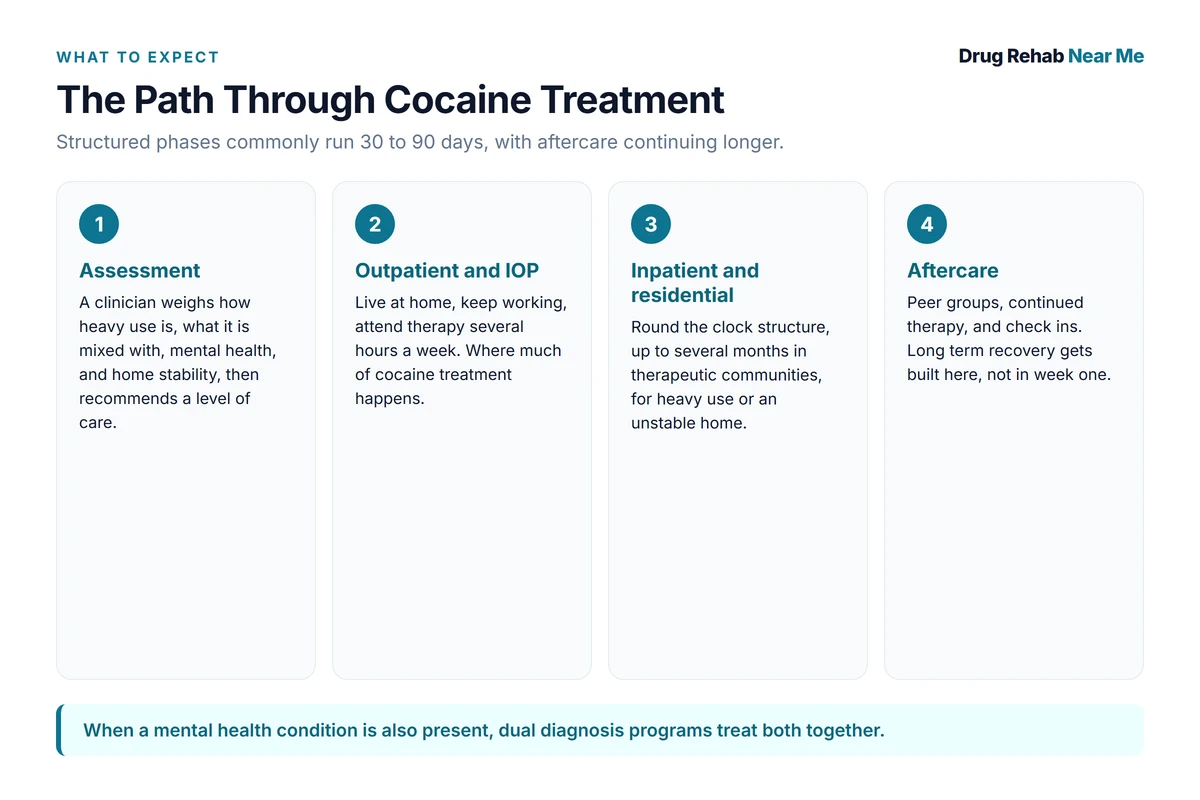
Outpatient and intensive outpatient (IOP) is where much of cocaine treatment happens. You live at home, keep working, and attend therapy several hours a week, more for IOP. The heavyweight therapies above, contingency management included, were validated in outpatient settings. You can see how these programs are organized in a state near you, for example intensive outpatient programs in California.
Inpatient and residential care means living at the facility with structure around the clock. It fits heavy daily use, repeated failed outpatient attempts, or a living situation soaked in the drug. Therapeutic communities are the longer form of this idea. Browse inpatient programs in Florida to see what that level looks like in practice.
Dual diagnosis programs treat addiction and mental health conditions together, which NIDA flags as essential when both are present. If cocaine use sits on top of depression, anxiety, or another condition, treating only one side rarely holds; dual diagnosis programs in New York are one example of how states organize this care.
On timing: programs commonly run 30, 60, or 90 days for structured phases, with outpatient and aftercare continuing longer, and research consistently favors staying engaged over rushing out. Our guide to how long rehab takes breaks the timelines down honestly.
Two Dangers Worth Knowing About
First, the supply problem. Cocaine is increasingly cut with fentanyl, a synthetic opioid strong enough that people with no opioid tolerance can stop breathing. Federal overdose data for 2021 counted 24,486 deaths involving cocaine, and more than 15,000 of them also involved synthetic opioids like fentanyl. If someone who has used cocaine becomes unresponsive or their breathing slows, call 911 immediately and give naloxone (Narcan) if it is available. There is no home remedy for a cocaine overdose; 911 is the treatment.
Second, the alcohol combination. Many people drink while using cocaine, and the two substances react in the body to form cocaethylene, a compound NIDA notes may increase the toxic effects on the heart. If you take one thing from this section: cocaine plus bar night is not a softer version of the problem, it is a harder one.
How to Get Started
Whether this is for you or someone you love, the move is the same: turn a vague intention into one concrete step today. That can be as small as one phone call with two questions: "Do you offer contingency management for stimulant addiction?" and "Are you in network with my insurance?" A program's answers tell you most of what you need to know about them. And if it is someone you love, skip the ultimatum; offering to sit together while you call is a smaller ask, and smaller asks get taken.
If money is the thing stopping you, it should not decide this alone. Coverage is more common than people assume, and cash prices are more negotiable than the sticker suggests; our guides to what rehab costs and how insurance covers rehab walk through it without the fine print fog.
From there, you can browse real programs by state, for example in Florida or New York; every listing shows the payment options each facility reports to the federal directory, so you can filter before you dial. Or call (888) 470-5244 and talk it through with a person, any hour. If there is a mental health crisis or any talk of self harm, call or text 988 now, and treat a suspected overdose as a 911 call, always.
Frequently Asked Questions
How is cocaine addiction treated?
With behavioral therapies: contingency management, cognitive behavioral therapy, motivational interviewing, and structured programs from outpatient to residential. There is no FDA approved medication for cocaine use disorder, so choosing a program with strong behavioral treatment is the whole game.
Can cocaine addiction be cured?
Addiction is treated and managed rather than cured, the same way conditions like diabetes are managed. Many people reach lasting recovery, and research now counts sustained reductions in use as meaningful progress too, not just perfect abstinence.
How long is rehab for cocaine?
Structured programs commonly run 30 to 90 days, with intensive outpatient phases often lasting several weeks beyond that and aftercare continuing months longer. Longer engagement is consistently associated with better results, so be wary of anyone promising a quick fix.
Is crack cocaine addiction treated differently?
The evidence based treatments are the same: contingency management, CBT, and structured levels of care. Crack's faster, more intense cycle often means a higher level of structure helps early on, which is a decision an assessment settles, not a different medicine.
Can you quit cocaine without rehab?
Some people do, usually with support groups, therapy, and real changes to their environment. The honest caveats: the post-quit crash can bring heavy depression, and daily or binge use, or a co-occurring mental health condition, makes going it alone much harder. A professional assessment costs you one conversation and removes the guesswork.
What should you do if someone overdoses on cocaine?
Call 911 immediately; cocaine overdose can involve seizures, heart attack, or stroke, and none of those are manageable at home. Because cocaine is increasingly cut with fentanyl, give naloxone if it is available, even if you believe only cocaine was involved.
Free & confidential, 24/7
Not sure which program fits? Talk it through with someone who can help.