Meth addiction is treatable, but not with a pill. There is no FDA approved medication for meth addiction, so the meth addiction treatment that actually works is behavioral: contingency management, cognitive behavioral therapy, and structured programs like the Matrix Model. The National Institute on Drug Abuse calls contingency management the best studied of these and the one most closely tied to success.
That answer is strangely hard to find. Search this topic and you get academic journal papers, university press releases, and rehab marketing pages that dance around the medication question because the honest answer sounds less impressive than a prescription. So this guide says it plainly, then covers the rest: how to recognize the signs of meth use, what the effective treatments actually involve, and how to find a real program.
One thing to know up front: this site is a directory, not a treatment provider. If you would rather talk through your situation with a person than keep reading, you can call (888) 470-5244 any time. It is free and confidential.
Why Meth Is So Hard to Quit
Methamphetamine is a synthetic stimulant with a high addiction potential, and that phrase from the research world understates what people actually experience. Meth floods the brain's reward system, producing a rush of energy, confidence, and euphoria that ordinary life cannot match. Then comes the crash: exhaustion, low mood, and a brain that has started recalibrating what "feeling normal" even means.
With repeated use, the pattern hardens into binges, crashes, and cravings that can persist for months after someone stops. Long term use is linked to insomnia, memory problems, anxiety, and paranoia. None of this means the person is weak. It means their brain's motivation circuitry has been retrained around the drug, which is exactly why "just stop" so rarely works and why structured treatment exists.
The realistic frame is this: quitting meth is genuinely hard, and people do it every day with the right support. Both halves of that sentence are true.
Signs of Meth Use: What to Look For
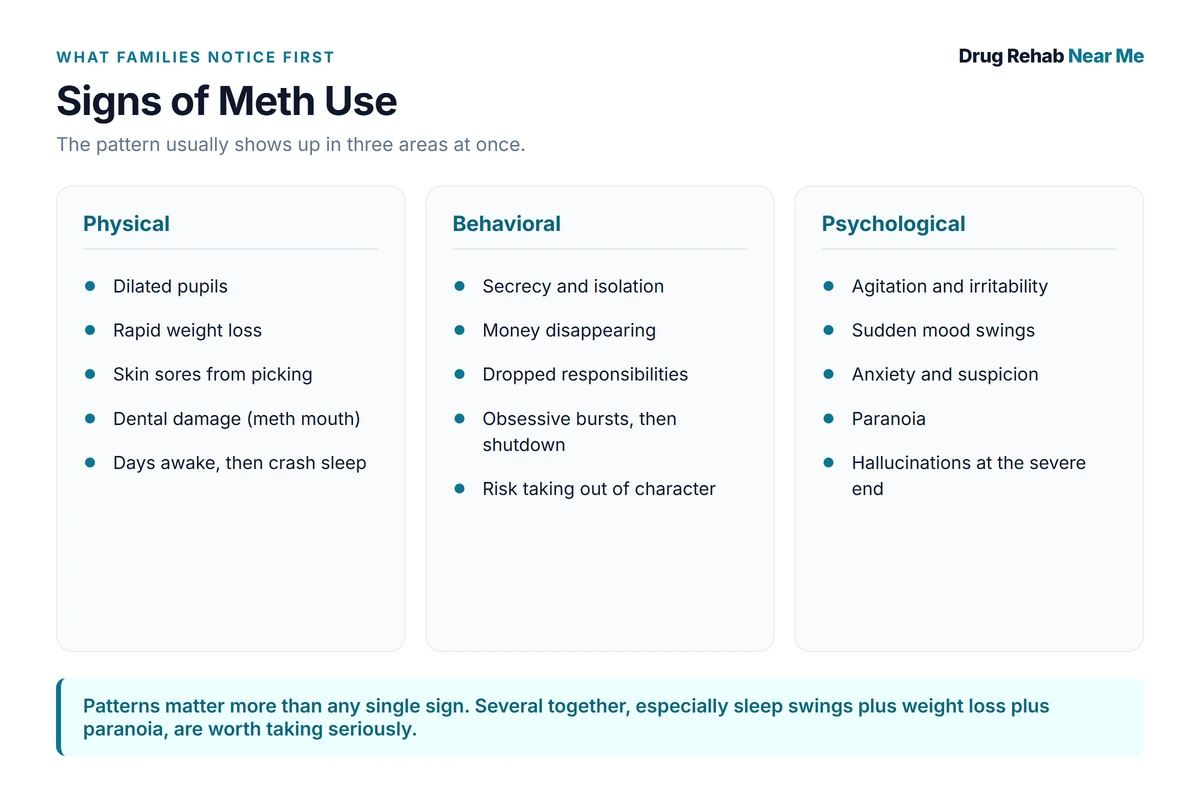
Most people researching this topic are not the person using meth. They are a parent, partner, or friend trying to confirm a fear. No single sign proves anything, but the pattern below is distinctive, and it tends to show up across three areas at once.
Physical signs
- Dilated pupils that stay enlarged even in bright light.
- Rapid weight loss. Meth suppresses appetite hard; people skip meals for days and develop a gaunt look.
- Skin sores, often from repetitive picking or scratching, that heal slowly.
- Dental damage, the "meth mouth" pattern of decay, gum disease, and broken or missing teeth.
- Extreme sleep swings: days awake with intense energy, followed by a crash of 24 hours or more of sleep.
Behavioral signs
- Secrecy and pulling away from family and old friends.
- Money disappearing without explanation, borrowing, or selling belongings.
- Missed work or school, dropped responsibilities, and lost interest in things they used to care about.
- Bursts of obsessive activity, like taking things apart or cleaning for hours, followed by total shutdown.
- Risk taking that seems out of character.
Psychological signs
- Agitation, irritability, and sudden mood swings.
- Anxiety and suspicion that tips into paranoia.
- At the severe end, hallucinations or full meth psychosis: hearing voices, seeing things, or the crawling-skin sensation that drives picking.
These meth addiction symptoms rarely arrive alone. If you are seeing several of them together, especially the sleep swings plus weight loss plus paranoia combination, trust the pattern over any single explanation. And if the person is talking about hurting themselves, do not wait for a better moment: call or text 988, the national crisis line, right away.
Is There a Medication for Meth Addiction?
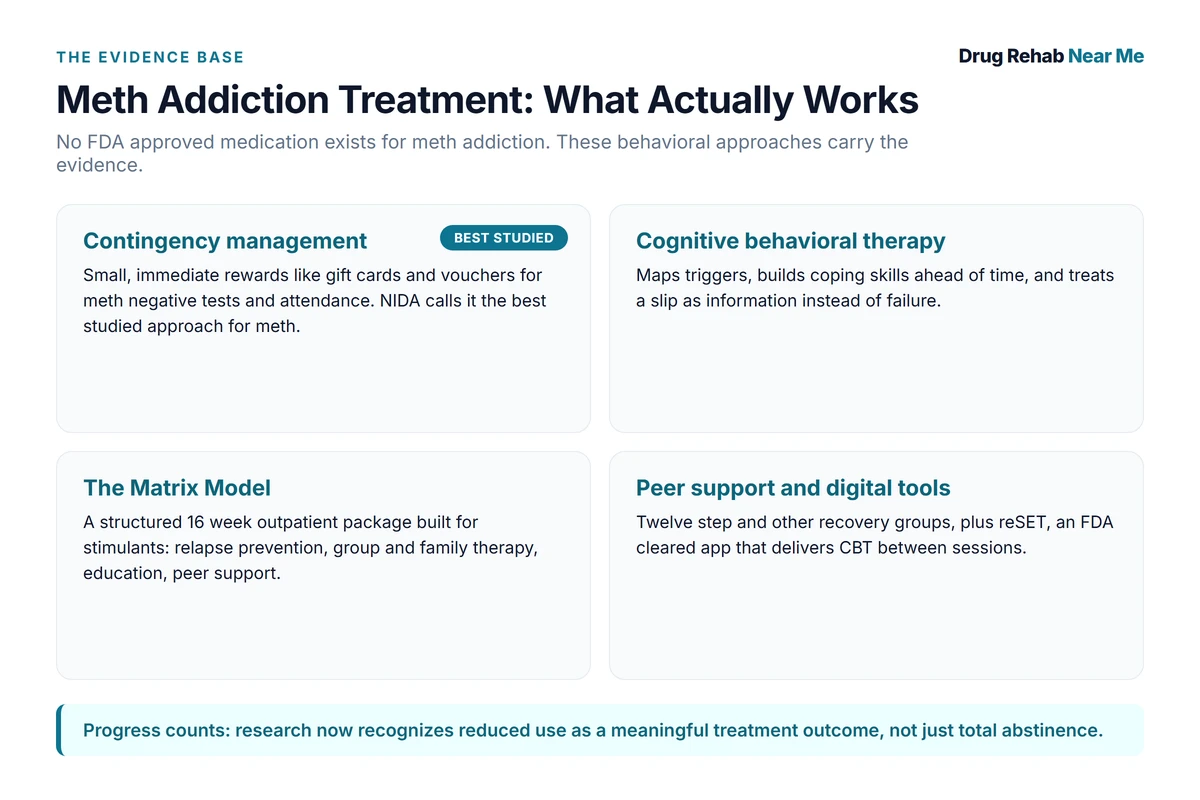
No. There is no FDA approved medication for methamphetamine use disorder, or for any stimulant use disorder. That is the current position of the National Institute on Drug Abuse, and any program that promises a medical cure for meth addiction is telling you something the science does not support.
That said, medication is not useless in meth recovery. Doctors routinely prescribe existing medications during treatment for the problems that ride along with quitting: depression, anxiety, and wrecked sleep. Treating those makes it far easier to stay in a program long enough for it to work.
Research is also moving. A phase 3 clinical trial published in 2021 found that a combination of bupropion and injectable naltrexone helped a meaningful subset of people with moderate to severe meth addiction reduce their use. It is not FDA approved for this purpose, and researchers are still studying it, but it is the most promising medication result so far, and it is worth asking any prospective program whether their medical staff stays current on this research.
Until that changes, the honest summary is: medication can support the person, but the treatment itself is behavioral. Here is what that means in practice.
The Treatments That Work
Contingency management
Contingency management is the best studied treatment for meth addiction and the one NIDA says is most associated with success. The concept sounds almost too simple: people earn small, immediate rewards, like gift cards, vouchers, or prizes, for meth-negative drug tests and for showing up to treatment. It works because it fights meth on its own turf. The drug trains the brain to chase immediate reward, so recovery goes better when staying sober produces immediate rewards too, instead of only distant ones like "your health will improve". Not every program offers contingency management, partly because of old funding rules, so ask directly: "Do you use contingency management for stimulant treatment?" The answer tells you a lot about the program.
Cognitive behavioral therapy
Cognitive behavioral therapy, or CBT, teaches the practical skills: spotting the people, places, and feelings that trigger use, building specific responses ahead of time, and treating a slip as information instead of proof of failure. It is the workhorse of stimulant treatment, and the same toolkit anchors cocaine addiction treatment, which shares the same core problem: no approved medication, so skills carry the load.
The Matrix Model
The Matrix Model is a structured outpatient package built specifically for stimulant addiction. Over roughly 16 weeks it combines relapse prevention, individual and group therapy, family involvement, drug education, and peer support on a fixed schedule. For someone whose weeks have been organized around a binge and crash cycle, the structure itself is part of the medicine.
Motivational interviewing, peer support, and digital tools
Motivational interviewing helps people work through the "do I even want to quit" question honestly instead of being lectured about it. Twelve step and other peer groups give recovery a social home, which matters for a drug that isolates people. There is even an FDA cleared smartphone app, reSET, that delivers CBT lessons between sessions. None of these replace the heavier tools above; good programs stack them.
One more piece of honesty, because it changes how families judge progress. In 2024, NIH backed research made the case that reduced meth use is a meaningful treatment outcome, not just total abstinence. Someone who goes from daily use to occasional use has measurably better health and a real foundation to build on. Relapse does not erase progress either; it usually means the treatment plan needs adjusting, the same way a blood pressure plan gets adjusted.
What Meth Addiction Treatment Looks Like: Levels of Care
The therapies above get delivered inside a level of care, and choosing the level is usually the first real decision. Some people also start with a short, medically supervised detox to get through the first days safely; any program you call will tell you whether that step applies. If you are new to all of this, our plain guide to what rehab actually is is a good primer.
Inpatient and residential programs mean living at the facility with round the clock support. This level fits heavy daily use, meth psychosis, a home environment where everyone uses, or previous failed attempts at outpatient care. You can see what operates in a given state, for example inpatient programs in California.
Outpatient and intensive outpatient programs let people live at home and keep working while attending treatment several hours a week. This is not the discount option; contingency management and the Matrix Model were built as outpatient treatments, so much of the strongest evidence for meth lives at this level. Browse outpatient programs in Texas to see the shape of what is offered.
Dual diagnosis programs treat addiction and mental health together. If paranoia, depression, or psychosis is part of the picture, a program that only addresses the drug is solving half the problem; dual diagnosis programs in Florida are one example of how these are organized.
On timeline: structured stimulant programs commonly run 12 to 16 weeks, with support continuing after. Our guide to how long rehab takes breaks down the standard program lengths.
The Overdose Risk Nobody Should Skip
Yes, you can overdose on meth, and the risk has changed in a way many families have not heard about. According to CDC research cited by NIDA, meth is now the second most common drug found in fatal overdoses, behind synthetic opioids like fentanyl. Part of the reason: fentanyl increasingly shows up mixed into street meth, sometimes without the buyer knowing.
Two practical takeaways. If someone using meth has slowed or stopped breathing, treat it as a possible opioid overdose: call 911 and give naloxone (Narcan) if it is available, because fentanyl may be involved. And if someone is still using while waiting for a treatment date, naloxone within reach is a reasonable precaution, not an accusation.
How to Get Someone Into Treatment
If you are reading this for someone else, the goal of the first conversation is small: not a confession, not a promise to quit forever, just agreement to one concrete step. Pick a calm moment, not mid-crash and not mid-argument. Name what you have seen without piling on. Then offer the step: "Will you sit with me while I call and ask some questions?"

Money worries stop a lot of these calls before they start, usually unnecessarily. Insurance plans are required to cover addiction treatment, and options exist for people with no insurance at all; our guides to what rehab costs and how insurance covers rehab walk through the real numbers.
When you are ready to look at actual programs, you can browse facilities by state, for example in California or Texas; every listing shows the payment options each facility reports to the federal directory. Or skip the browsing and call (888) 470-5244 to talk it through with a person. And in a crisis, use the crisis tools: 988 for a mental health emergency, 911 for an overdose.
Frequently Asked Questions
Can you overdose on meth?
Yes. Meth overdose can cause stroke, heart attack, or dangerous overheating, and CDC data shows meth is the second most common drug found in fatal overdoses. Because street meth is sometimes mixed with fentanyl, call 911 for any suspected overdose and give naloxone if available.
How long does meth addiction treatment take?
Structured programs for stimulants commonly run 12 to 16 weeks; the Matrix Model, built for meth, is a 16 week program. Recovery support usually continues well beyond that, since cravings can persist for months after quitting.
Can meth addiction be treated without going to inpatient rehab?
Often, yes. Contingency management and the Matrix Model are outpatient treatments with strong evidence behind them. Inpatient care makes more sense for heavy daily use, psychosis, or a living situation that makes staying sober at home unrealistic.
What is meth psychosis, and does treatment help?
Meth psychosis means paranoia, hallucinations, or delusions brought on by heavy use. It needs medical attention, and many people improve substantially once they stop using and get proper care, which is why dual diagnosis programs that treat addiction and mental health together matter here.
Does insurance cover meth addiction treatment?
In most cases yes. Federal law requires most health plans to cover substance use treatment comparably to other medical care, though the details vary by plan. Our insurance guide explains how to verify coverage in one phone call.
What if they relapse after treatment?
Relapse is common with meth and it is not proof that treatment failed. Research now recognizes reduced use as meaningful progress, and a relapse typically means the plan needs adjusting, more structure, a different therapy mix, or a higher level of care for a while.
Free & confidential, 24/7
Not sure which program fits? Talk it through with someone who can help.